Scan, when the next move is unclear
Use a Scan when leadership is weighing a pilot, vendor, repository, or hire and needs an outside read on whether the evidence, workflow, ownership, and review burden are ready. 1-2 weeks.
Engagement shapes
Scan diagnoses. Pilot tests. Run sustains. Every engagement is scoped around the decision it has to improve, the evidence it has to inspect, and the owner who has to act on the answer.
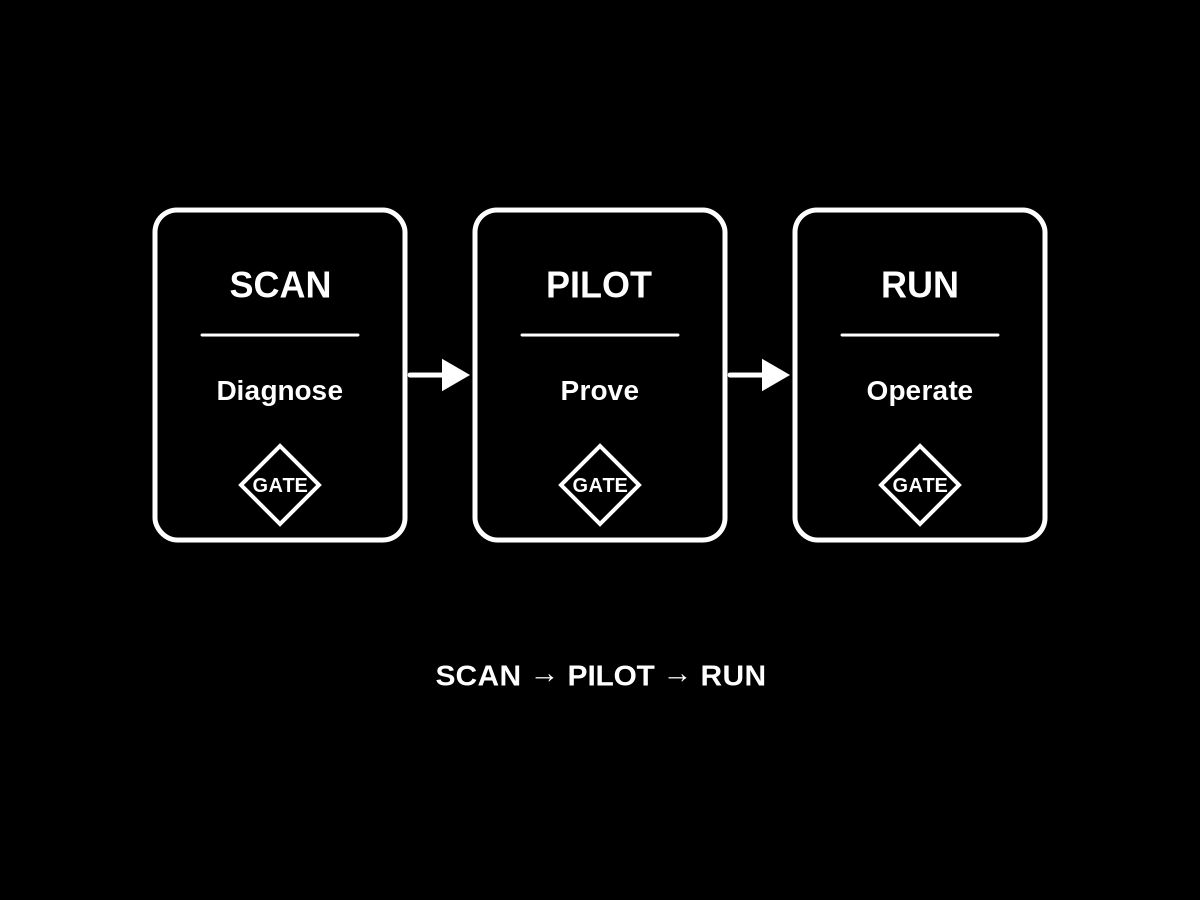
When each shape fits
Use a Scan when leadership is weighing a pilot, vendor, repository, or hire and needs an outside read on whether the evidence, workflow, ownership, and review burden are ready. 1-2 weeks.
Use a Pilot when a Scan has already exposed the decision, the data is reachable, and a narrow, time boxed experiment can produce a clean go / fix / stop signal. 2-8 weeks.
Use Run when the organization keeps generating AI, data, and vendor decisions and needs an external reviewer who already knows the substrate, the agents, and the failure modes. Recurring cadence.
Scan
The Scan inspects the target decision, the evidence chain behind it, the workflow that will have to execute it, the ownership and review model, and the assumptions baked into any vendor or pilot already in motion. It is deliberately short, long enough to be honest, short enough to stay decision grade.
Decision under consideration, data and document samples, vendor materials, prior pilot artifacts, and access to two to four practitioners.
A short written memo: what is ready, what is fragile, what to fund, fix, pilot, buy, scale, defer, or stop, and the smallest defensible next move.
No model building, no code delivery, no procurement intermediation, no headcount design. The Scan is judgment, written down.
Pilot
A Pilot follows a Scan when the recommendation is “test it” rather than fund, fix, buy, or stop. The Pilot defines the success criteria, the evidence each side will accept, the reviewer, the logging requirements, and the decision the result will unlock, all before any model, prompt, retrieval system, or agent is built.
Pilot charter from the Scan, a named decision owner, data access, and clarity on which workflow is being tested versus simulated.
A pilot record: what was tested, what evidence was produced, what the result implies for fund / fix / scale / stop, and what the organization now owns.
Open ended exploration, vendor “innovation spectacle,” or pilots whose definition of success can drift after the fact.
Run
Run is for teams whose AI, data, and vendor questions do not stop after one Scan. SignalForge holds a recurring cadence: scheduled reviews of new pilots, vendor claims, agent behavior, evidence drift, and decisions in motion, with the same diagnostic discipline applied each time.
A standing decision queue, access to the relevant evidence and workflow owners, and a clear escalation path for items the cadence flags.
Periodic decision memos, vendor and pilot reviews, and a running record of what the organization chose to fund, fix, defer, or stop, and why.
Open ended retainer with no decisions attached. Run is a cadence around live questions, not a monthly availability fee.
How they connect
Most teams start with a Scan. A Scan may recommend a Pilot, recommend a fix or buy without a pilot, or recommend stopping. Run is for organizations that, after one or two engagements, decide they want an outside reviewer permanently in the loop on AI, data, and vendor decisions.
Choose the shape that matches the question
The fit screen takes the active decision, the evidence already on hand, the workflow involved, and the time pressure, and recommends which of Scan, Pilot, or Run is honest for the situation. If none of them fit, the screen will say so.