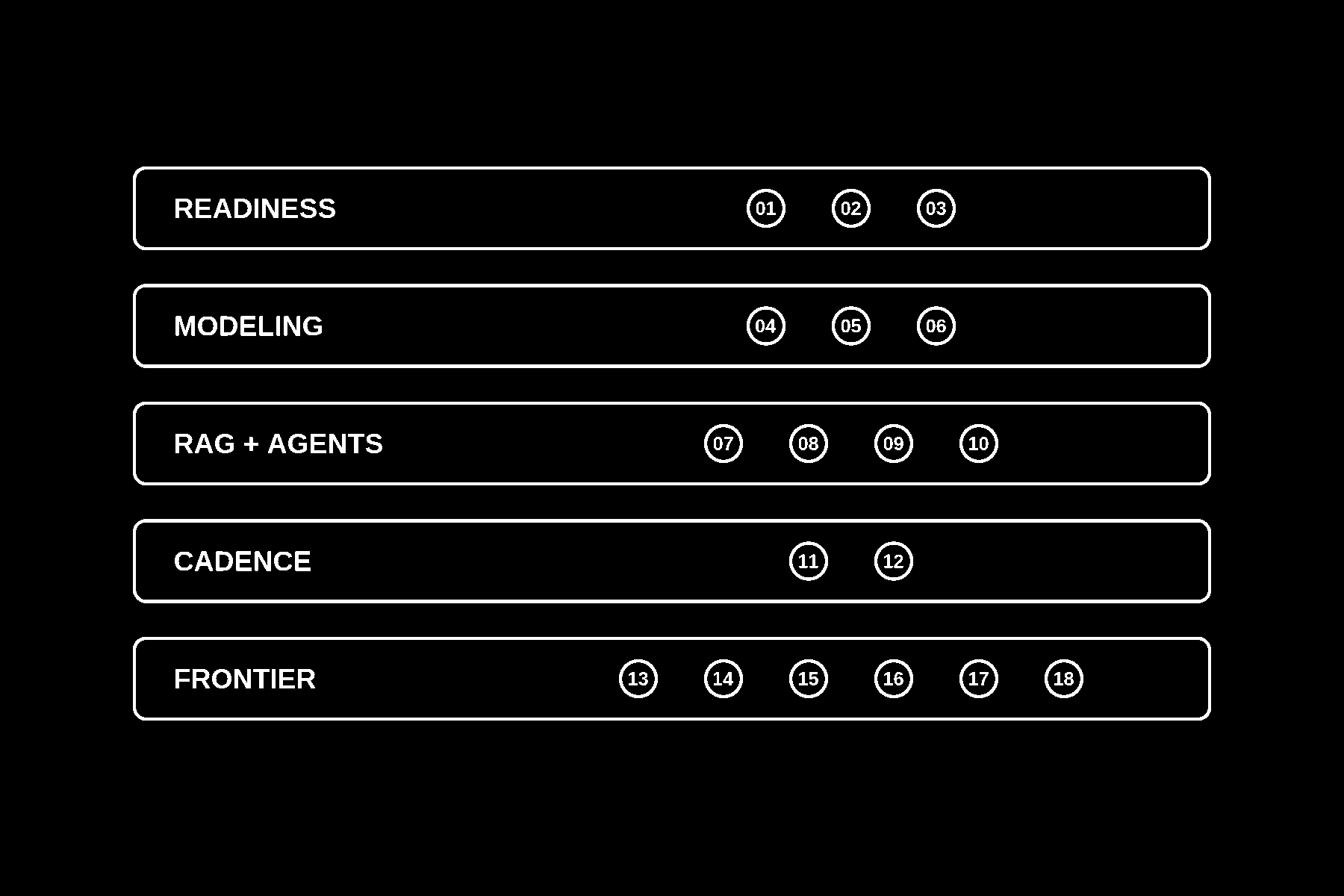
These playbooks are diagnostic patterns for life sciences teams facing AI pressure, fragile evidence, scattered knowledge, vendor claims, stalled pilots, weak model evaluation, or agentic systems without a trusted substrate.
Each playbook asks what is probably breaking, why the obvious fix fails, what SignalForge would inspect first, and what leadership should be able to decide after a Scan or Pilot.
Diagnostic library — five tracks, eighteen named playbooks
Readiness and evidence substrate
Readiness and evidence substrate
Use these when AI ambition depends on problem definition, lab context, instrument flow, omics lineage, or old evidence that may or may not be worth rescuing.
Your lab has assay outputs, but the context needed to interpret those outputs is scattered across ELNs, spreadsheets, instrument exports, slide decks, SharePoint folders, and memory.
Risk: preserving the result while losing the context that makes the result interpretable.
Decision: the organization’s wet lab evidence is ready to be reused, scaled, modeled, retrieved, or automated, or whether the capture layer must be repaired first.
Instrument data exists, cloud storage exists, and teams still cannot tell which file, database row, script output, or report is the authoritative record.
Risk: buying infrastructure and calling it a data substrate.
Decision: a practical executive decision: whether the organization should repair the instrument data flow, pilot a focused ingestion and repository pattern, challenge a platform assumption, or stop treating storage as evidence infrastructure.
Your team has omics plots, feature tables, study summaries, or model inputs, but cannot confidently reconstruct the computational path from sample to result.
Risk: making the figure easier to find than the computational path that produced it.
Decision: this playbook helps leadership decide whether an omics or computational output is actually ready for the next decision.
Years of historical life sciences data exist, but no one can say which records are usable, trustworthy, repairable, or relevant to a current decision.
Risk: launching a broad archive cleanup, data lake migration, cataloging effort, or AI ingestion program because the historical data “might be valuable.” In life sciences, old records do not...
Decision: historical data rescue gives leadership a practical fork: rescue a specific archive, sample before committing, repair a narrow metadata layer, run a bounded reuse pilot, generate new evidence instead, or stop treating historical data as a vague strategic asset.
The team is debating model types before proving what the decision actually requires.
Risk: choosing a model class before proving what the decision requires.
Decision: this playbook helps the buyer make a method choice decision before committing budget, vendor dependency, compute, integration work, or review burden.
An AI workflow is producing useful outputs, but the organization cannot reliably reconstruct how those outputs were created.
Risk: scaling AI usage faster than the organization can inspect, log, review, and correct it.
Decision: this playbook helps leadership decide whether an AI workflow is safe to scale, needs logging and review repair, should stay manual, or should be restricted to lower risk uses.
Private RAG matters when the organization has valuable knowledge scattered across reports, SOPs, protocols, slides, PDFs, ELNs, SharePoint folders, meeting notes, market files, and personal archives, but users cannot reliably find, interpret, or trust it.
Risk: building a private chatbot over an ungoverned library.
Decision: private RAG is ready to become a knowledge workflow, or whether the organization is about to spend heavily on a search interface over an evidence mess.
A team wants persistent AI support for research, competitive intelligence, business development, market monitoring, vendor tracking, or internal workflow follow up.
Risk: giving an agent a recurring job before defining the job.
Decision: this playbook helps leadership decide whether the recurring task is ready for persistent agency or whether the organization is trying to automate an undefined judgment process.
An AI vendor demo looks credible, but you are not sure whether the claim survives your real data, metadata, workflows, permissions, review gates, and decision context.
Risk: evaluating the demo instead of the operating burden.
Decision: the most important decision is not “Do we like this vendor?” It is “What should we do next, given the evidence and burden?” A strong vendor claim may deserve procurement if the evidence is...
Use these when leadership is thinking about scientific intelligence layers, frontier model access, future capability controls, or external signal monitoring.
Life sciences teams want agents, persistent scientific intelligence, or cross functional AI assistants, but the evidence base is fragmented across experiments, omics outputs, documents, repositories, vendor inputs, and decisions.
Risk: deploying disconnected copilots and then trying to retrofit governance after people have already started trusting them.
Decision: a leadership decision about whether the organization should build a scientific intelligence layer, repair the evidence substrate first, pilot one narrow agent role, or defer agentic capability until the foundation is ready.
Leadership expects frontier models to become more capable, but the organization has not defined what those models are allowed to do.
Risk: watching model capability accelerate while the company’s internal controls remain primitive.
Decision: this playbook helps leadership decide which workflows are safe for AI assistance, which require strict human control, which need new evaluations, and which should not be delegated even as models become more capable.
Patents, publications, clinical updates, vendor claims, regulatory signals, BD activity, and competitor moves are arriving faster than your teams can interpret them.
Risk: adding more alerts before designing strategic vigilance.
Decision: this playbook helps leadership decide whether an agentic monitoring layer would reduce strategic blind spots or simply create a more sophisticated form of noise.
If a playbook feels uncomfortably familiar, send the problem. SignalForge will help determine whether the right next move is a Scan, Pilot, Run cadence, vendor diligence, substrate repair, or no project.
Send the active problem, the result you need, the evidence you can point to, and the timeline.
SignalForge responds with whether the brief is worth a no cost screen.
Where the brief lands cleanly, the first paid step is usually a focused Scan.
Where there is no fit, the recommendation will say so without ceremony.