Corpus classes
Identify major document types (SOPs, protocols, reports, ELN exports, patents) as each carries different authority and risk.
Playbook 09
Valuable internal knowledge is scattered across SOPs, protocols, reports, PDFs, ELNs, SharePoint, slides, meeting notes, and personal archives.
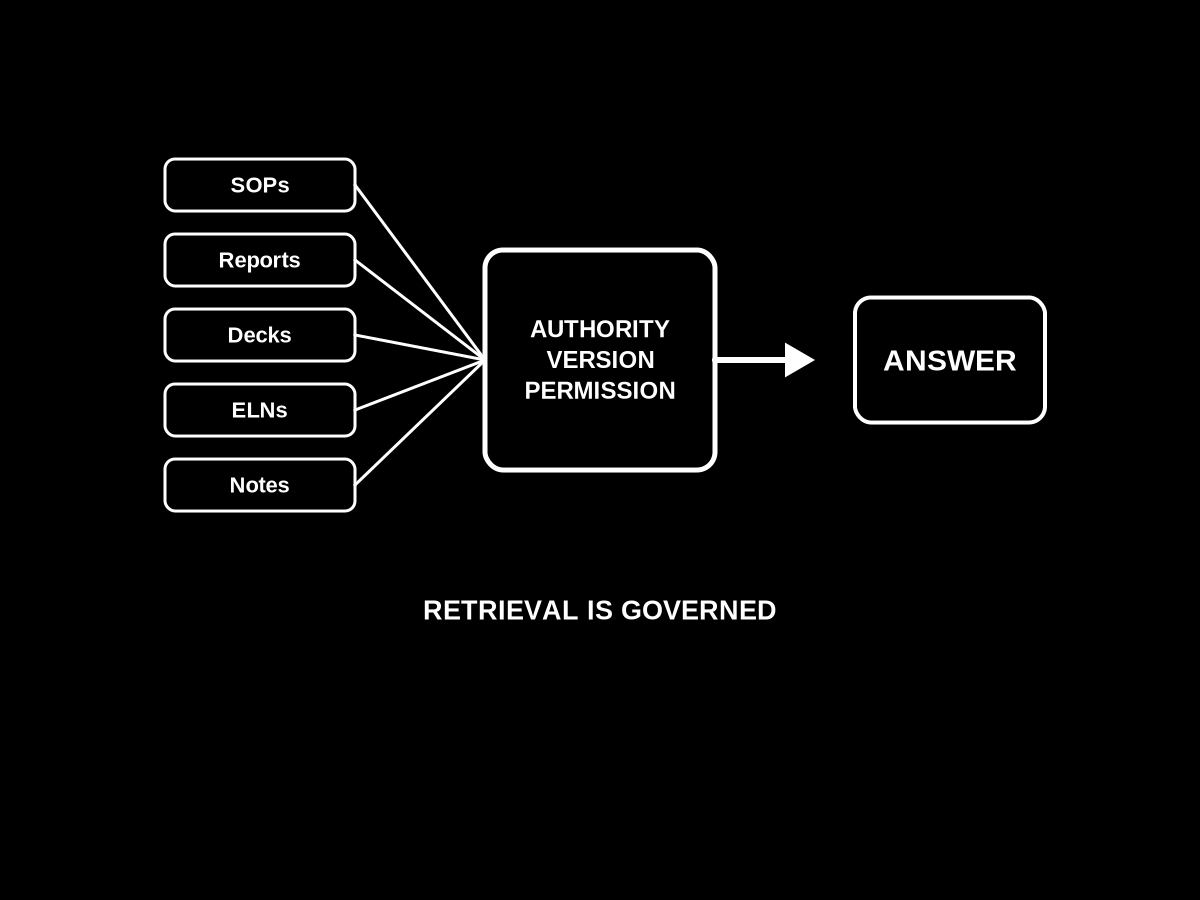
The dump it in RAG mistake
Building a private chatbot over an ungoverned library is an expensive mistake. Retrieval doesn't know which documents deserve authority unless the system is designed to know. In life sciences, an approved protocol, a draft biomarker plan, and an executive summary differ significantly in meaning, audience, and actionability.
Why retrieval misleads
Most private knowledge and RAG failures in life sciences stem from library governance, not model deficiencies.
Knowledge is distributed across systems not designed as a single evidence layer. SOPs, assay reports, and BD signals reside in varied formats. While RAG can retrieve this material, retrieval isn't judgment. Without encoded source authority, a draft deck and an approved memo can be treated equally. Unclear version status can lead to superseded protocols; messy permissions expose sensitive materials; duplicated documents result in citing non-authoritative copies.
This explains why pilots often demo well but struggle. A user asking about current sample handling might get four documents—a protocol, training, CRO note, and deviation discussion—but only one is authoritative. Without an authority hierarchy, the model improvises across evidence classes.
Chunking also fails in life sciences. Key meaning often resides in tables, figures, reagent lists, inclusion criteria, or statistical caveats. Generic chunking splits these elements, damaging evidence before the model sees it.
Citation quality is frequently misunderstood. A citation must point to the right file, version, section, evidence class, and context. "Source included" is insufficient; users need to know if a source is approved, draft, superseded, or restricted.
Evaluation is often shallow. Teams test common questions but not the system's ability to refuse unsupported queries, resolve conflicts, identify obsolete material, preserve caveats, or respect permissions. The system may excel at easy retrieval but fail on critical decision questions.
Leaders request scale, users demand trust, IT seeks architecture, legal and quality raise concerns, and scientific teams question ignored caveats. Vendors present benchmarks, but no one agrees on the corpus’s intended meaning. The real work is defining eligible knowledge, representing authority, testing retrieval, inspecting citations, enforcing permissions, logging failures, and approving supported decisions.
Curating the corpus
SignalForge treats private knowledge and RAG systems as governed evidence access workflows, not chatbot deployments.
First, define the decision context; RAG needs vary for assay troubleshooting vs. BD landscape review. Each use case has distinct sources, risks, permissions, and review needs.
SignalForge categorizes the corpus into practical evidence classes: controlled SOPs, approved protocols, ELN exports, slide decks, and external reports. The goal is to identify which classes support the initial workflow and which require exclusion, quarantine, or warnings.
SignalForge then inspects the authority structure: current vs. superseded documents, drafts, official decisions, external inputs, and how the system handles conflicting sources.
This process informs a bounded RAG pilot testing retrieval quality, chunking, source ranking, citations, permissions, logging, refusal behavior, and human review. The aim is to prove a defined corpus and workflow can support decision-grade knowledge, not ingest an entire library.
In a Scan, SignalForge maps the document environment, flags high-risk corpus issues, defines the first viable use case, and recommends next steps. In a Pilot, SignalForge tests one workflow with real documents, users, and evaluation criteria. In Run, SignalForge advises on corpus evolution, vendor claims, and expansion.
RAG pressure points
Identify major document types (SOPs, protocols, reports, ELN exports, patents) as each carries different authority and risk.
Inspect if the system distinguishes approved, current, superseded, draft, and informal materials.
Check for reliable dates, version numbers, approval status, owners, and supersession links, not just file modified dates.
Assess if folder access, document-level permissions, and program restrictions can be enforced.
Look for repeated decks, copied PDFs, and renamed files causing citations of stale or non-authoritative versions.
Test if tables, figures, captions, protocol steps, caveats, and scanned pages survive ingestion intact.
Inspect if citations lead to the exact supporting section with context to verify answers and detect caveats.
Define test questions covering protocol lookup, conflicting source resolution, caveat preservation, and permission-sensitive queries.
Identify materials to exclude from the initial corpus, such as draft strategy notes or outdated training copies.
Examine if prompts, retrieved sources, answers, user feedback, and failures are sufficiently captured for improvement and governance.
RAG readiness memo
A Private Knowledge / RAG Scan determines if an organization is ready to pilot, needs governance first, must narrow its use case, or should reject the concept.
Shows which document groups are suitable for first use, risky, or should be excluded.
Separates current approved materials, historical references, exploratory work, vendor deliverables, and restricted documents.
Identifies areas where access control may fail if retrieval scales too quickly.
Reviews representative documents like assay protocols, SOPs, and PDFs with tables/figures for chunking and citation issues.
Includes questions the system should answer, qualify, and refuse.
Includes proposed scope, corpus boundaries, user group, success/failure criteria, review process, and decision points.
Offers a stop or fix recommendation if the document environment isn't RAG-ready, emphasizing that a trusted system must be earned, not just built.
A scoped retrieval trial
A 2-8 week pilot can test private RAG for one program’s assay and translational evidence library.
The pilot corpus includes current and selected historical assay protocols, validation reports, ELN exports, CRO reports, internal slide summaries, publications, and decision memos for one program. It excludes uncontrolled personal folders, draft strategies, and unrelated archives.
The pilot tests practical questions like current sample handling, protocol version changes, biomarker threshold evidence, assay caveats, and CRO report interpretations, identifying conflicting sources.
Success is measured by retrieval finding the correct source class, preserving caveats, citing the right section, respecting access, flagging obsolete material, refusing unsupported questions, and generating answers efficient for scientific review.
Build, narrow, or defer
The decision: Is private RAG a knowledge workflow or an expensive search interface over messy data? A pilot suits environments with sufficient corpus authority, permissions, and document quality. Corpus governance is needed when document status, ownership, or access rights are unclear. A narrower use case fits high enterprise ambition with small initial safe scope. Rejection is advised if seeking AI credibility without corpus credibility.
This prevents common misspend on infrastructure before trust is established. The choice is to build a governed private knowledge layer supporting specific, traceable decisions, or pause chatbot ambitions to fix the corpus. Leadership needs a clear path beyond "do nothing" or "scale the demo": prove one decision workflow with known documents, users, review gates, and failure modes to justify further investment.
RAG FAQ
No. Focus on one workflow, define key document classes, exclude risky materials, and test if a governed slice yields useful answers.
A platform provides infrastructure; it doesn't determine authoritative protocols, obsolete decks, source ranking, or safe answers—these are governance issues.
Life sciences documents carry critical scientific, operational, and regulatory context; the challenge is preserving evidence meaning, not just finding text.
Send this for the screen
Share a description of the workflow, user group, document systems, desired questions, and 10-30 example documents. Useful inputs include SOP categories, protocol examples, ELN descriptions, SharePoint maps, vendor demo notes, permission concerns, user questions, and failed RAG pilot observations.