Recurring job definition
What recurring burden does the agent reduce; what decision does it support?
Playbook 10
A team wants an agent to monitor, retrieve, summarize, draft, route, recommend, or act across recurring research or business development workflows.
The always on agent trap
Deploying a recurring agent without defining its job is an expensive mistake. "Monitor this space" in life sciences covers diverse workflows like literature surveillance or patent monitoring. Connecting an agent to sources before defining its role, permissions, memory, and review creates governance, evidence, and ownership problems.
Why persistence breaks first
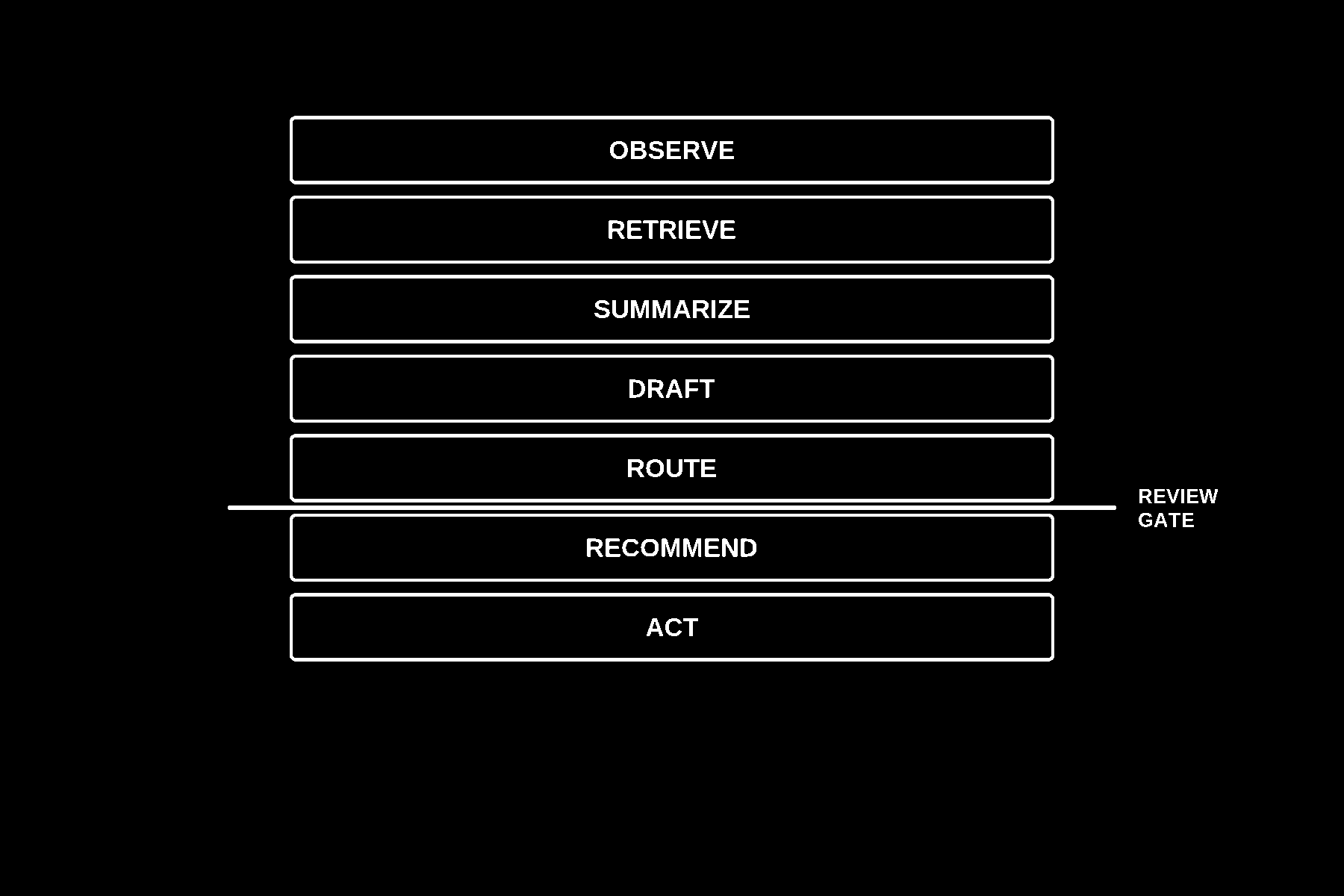
An agent is an operating system component, not a person. It lacks judgment and informal context. A persistent agent is a stack of capabilities, each with risks.
Observe: Agent watches defined sources. Risk: incomplete, stale, or biased sources lead to missed information.
Retrieve: Agent pulls supporting context. Issues arise with permissions and source quality. Should it access unpublished data?
Summarize: Agent compresses evidence. Quality depends on source provenance, chunking, citation, and distinguishing findings from claims. Summaries must preserve experimental context.
Draft: Agent creates communications. Overconfidence here can mask weak evidence or blur "changed" with "act now."
Route: Agent sends info/tasks to a person/system. This requires an ownership map. Without rules, agents spam or bottleneck decisions.
Recommend: Agent ranks or proposes next steps. This high-risk function needs explicit criteria: scientific plausibility, strategic fit, commercial attractiveness. Recommendations without criteria are just persuasive text.
Act: Agent changes things outside its workspace. In regulated environments, "updating a tracker" can influence decisions and records.
Most persistent agent failures result from collapsing these layers. Teams deploy agents from demos, assuming an operating model will emerge. Instead, the agent becomes too limited or untrustworthy. Define the recurring job with governable evidence, permissions, memory, review, and action.
Containing the agent
SignalForge defines the agent as a bounded operating component, not a vague digital colleague. We name its job: monitor a target, track competitors, etc. This shapes sources, review, and agency.
SignalForge then separates capabilities: observe, retrieve, summarize, draft, route, recommend, act. Each gets permissions, evidence needs, logging, and a human owner. Often, the first version is a persistent monitor that retrieves and drafts, with human review.
Source design is critical. SignalForge helps classify public, licensed, partner, confidential, regulated, and internal sources. A public literature update differs from a summary using confidential deal notes.
Memory policy is explicit. The agent needs durable memory for rules, temporary for drafting, and sometimes prohibited memory for sensitive data. SignalForge maps human handoffs: who reviews, approves, challenges, resolves uncertainty, and is accountable.
For Scan → Pilot → Run, this means starting with a diagnostic boundary, piloting one workflow, then maintaining cadence. SignalForge advises on inspectable AI/data workflows, not legal or compliance authority.
Agent pressure points
What recurring burden does the agent reduce; what decision does it support?
Which layers are in scope: observe, retrieve, summarize, draft, route, recommend, act, or a subset?
Which public, licensed, internal, confidential, partner, and regulated sources can the agent access?
Which users, groups, programs, or business units can see each class of input and output?
What persists, what is session-limited, what is deleted, and what is never stored?
What must the agent cite, snapshot, quote, or flag as unsupported?
Who reviews summaries, drafts, routes, recommendations, and proposed actions?
Which signals require human escalation, e.g., competitor clinical movement or safety information?
Which systems can the agent write to, if any, and what actions need human approval?
What is recorded: prompts, retrieval, source versions, model outputs, edits, and decisions?
Agent design memo
A Scan produces a practical operating packet for the proposed persistent agent.
This packet includes job definition, capability decomposition, source/permission map, memory policy, review/escalation model, logging spec, risk register, and initial pilot recommendation.
The Scan identifies if the task is ready for an agent, better suited to retrieval/drafting, needs human expert review, or is blocked by missing evidence infrastructure.
A bounded agent trial
A 4-6 week Pilot could test a persistent BD and research monitoring workflow for one therapeutic area.
The agent would observe public and approved internal sources (literature, patents, trials, competitor pages, internal watchlists), retrieve context, generate a weekly signal brief, draft an executive memo, and route flagged items to reviewers.
The pilot would prohibit autonomous outreach, CRM changes, or recommendations without human approval. Each run would log source coverage, evidence, citations, outputs, edits, escalations, and false positives/negatives.
The test focuses on whether the workflow becomes more reliable, inspectable, and decision-useful under real constraints, not just agent drafting ability.
Deploy, narrow, or stop
This playbook helps leadership assess if a recurring task is ready for persistent agency or attempts to automate undefined judgment. A pilot is viable if the job has stable sources, clear permissions, bounded memory, defined review gates, and decision paths. If it relies on tacit expert judgment, sensitive context, incomplete metadata, or unclear ownership, start with retrieval, drafting, or workflow visibility instead.
This avoids wasted spend on licenses, connectors, and compute for an ill-defined agent. It prevents connecting agents to sensitive systems only to find outputs untrustworthy. A bounded approach offers a clear choice: build a narrow agent, keep the process human-led, start with a monitored assistant, or first invest in source governance and infrastructure.
Agent FAQ
Yes, often the safest start, but still requires defined source registry, search strategy, update cadence, citation rules, and review owner.
Many teams should start with retrieval plus drafting, where the agent observes and drafts, but humans retain routing, interpretation, recommendations, and action.
A chatbot responds to user queries; a persistent agent has a recurring job, watching sources, noticing changes, preparing outputs, and influencing workflow.
Send this for screening
Send SignalForge the agent's recurring task, needed sources, systems, output recipients, and an example of a decision or handoff it supports.
Useful materials include sample briefs, memos, trackers, SharePoint maps, source lists, permission concerns, escalation examples, or current workflow screenshots. SignalForge helps determine if it's ready for a bounded agent, a retrieval/drafting pilot, or needs foundational evidence/ownership cleanup.