Evidence substrate
Identify all records, repositories, and decision artifacts agents rely on.
Playbook 15
Leadership wants persistent scientific intelligence across experiments, omics outputs, documents, repositories, agents, and decisions.
The overbuilt agent trap
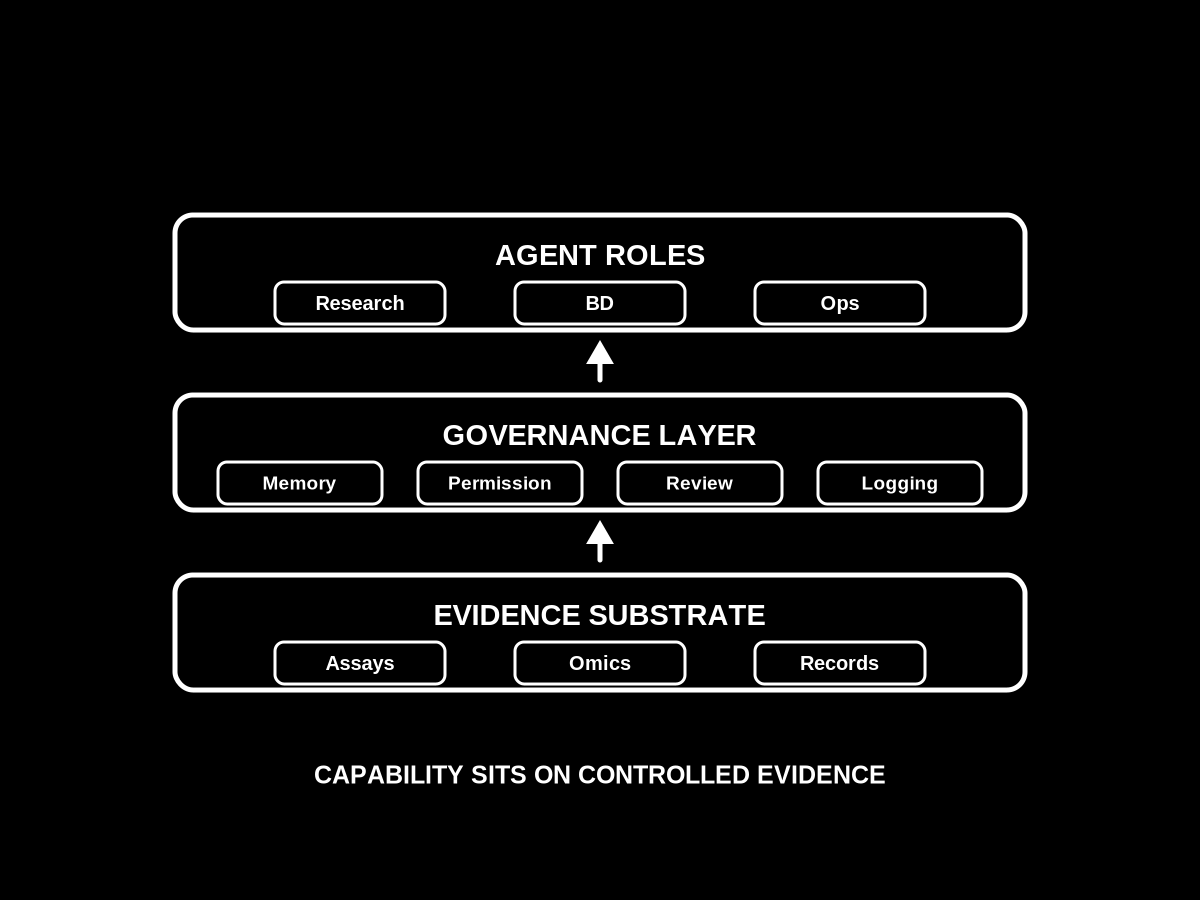
Deploying disconnected copilots without shared governance creates overconfident, under-informed agents. Lacking a shared substrate, permission model, or review workflow leads to partial confidence from partial context.
Why the layer stalls
Agentic capability fails when treated as an overlay instead of an emergent property of the scientific substrate. Distinguishing exploratory data from approved interpretations or vendor claims from internal results is crucial.
A scientific intelligence layer needs memory: observed data, producer, dependencies, version, context, pipeline, review status, and relevance. Without this, an agent retrieves artifacts but produces wrong answers.
Scientists and BD need answers from the same evidence, viewing a shared scientific memory. Organizations often lack this layer, instead having fragmented data across systems, leading to timid searches or overconfident agents.
Governance is critical for what an agent sees, remembers, and retains. Escalation requires defined owners, gates, logs, and decision context.
A durable intelligence layer needs staged capability: observation, retrieval, summarization, comparison, recommendation, and escalation. Skipping stages makes agent strategy a procurement exercise, yielding tools that answer questions but fail to improve decisions.
Making intelligence durable
SignalForge designs an agentic layer from the evidence base up, clarifying what persistent scientific intelligence should achieve.
We separate model capability from operating readiness. Key questions address the evidence substrate: authoritative records, metadata gaps, permissions, and review points. SignalForge specifies agent operational roles, ensuring defined memory, permissions, tools, and review gates.
Our practical approach defines memory policy, source confidence labels, retrieval boundaries, audit logs, review checkpoints, and capability stages. The goal is identifying the first safe pilot where agent-like workflows add value without automating scientific judgment.
Initial focus may include corpus repair, metadata normalization, or decision record design. A narrow pilot could involve an agent monitoring publications and assays to brief a scientific reviewer.
SignalForge’s Scan → Pilot → Run model fits this problem: a Scan identifies readiness, a Pilot tests a bounded role, and Run support ensures senior oversight as the layer expands.
The layer’s pressure points
Identify all records, repositories, and decision artifacts agents rely on.
Assess if experimental details, controls, and pipeline allow reliable retrieval.
Establish how the organization differentiates current SOPs, interpretations, and executive decisions.
Determine how agents enforce access boundaries across programs and sensitive data.
Define what an agent may retain, forget, or reuse across sessions and teams.
Implement labels for retrieved evidence freshness, origin, review, and reproducibility.
Ensure each agent role has a bounded job, allowed tools, and an escalation path.
Specify where scientific, quality, legal, or executive review is required.
Confirm that prompts, sources, tool calls, and approvals can be inspected.
Separate observation, retrieval, summarization, and escalation into safe maturity stages.
Scan artifacts
A Scan provides a concise view of whether an agentic scientific intelligence layer is ready to pilot, premature, or blocked.
Inventory covers ELNs, SharePoint, object storage, and decision archives.
Map outlines plausible roles now, those needing repair, and those to defer.
Documents source confidence, permissions, memory, review gates, logging, and decision workflows.
Scan recommends a pilot or stop, identifying substrate repairs needed before an agentic pilot.
A narrow agent test
A 2-8 week pilot tests a program evidence change agent for one therapeutic area.
This pilot uses a limited evidence set: internal memos, assay summaries, omics outputs, publications, patent alerts, and vendor materials. The agent observes new evidence, retrieves sources, labels confidence, identifies gaps, and briefs a scientific reviewer.
The test measures compliance with permissions, avoidance of stale sources, traceability, separation of claims, and escalation of uncertainty. Success means learning if a narrow agent role safely supports scientific review.
Build, defer, or stop
This playbook enables leadership to decide: build, repair, pilot, or defer agentic capability. This differs from a "which copilot to buy" decision, assessing if the company can create persistent, governed scientific memory that improves decisions.
Disconnected copilots incur high hidden costs. If the substrate is weak, invest in cleanup. If a workflow is ready, pilot a narrow agent role. If broader capability is desired, define staged expansion. The value is knowing whether to "build," "repair," "pilot narrowly," or "not yet."
Common questions
No. While RAG is a component, this playbook focuses on the governed layer around retrieval, including source confidence, permissions, memory boundaries, and decision context.
No, but the pilot's data dependencies must be acknowledged. A narrow pilot is useful even with imperfect data if sources are bounded, permissions clear, and outputs are treated as decision support.
Yes, if the role is carefully bounded. The layer can connect publications, patents, trial data, vendor claims, internal biology, assays, and prior decisions, highlighting the importance of source confidence and review gates.
Send this for screening
Send SignalForge a description of the agentic capability, involved systems, desired decision support, and existing examples of prompts, copilots, or repositories.
Useful materials include redacted program review decks, assay summaries, ELN screenshots, SOPs, data dictionaries, vendor diagrams, model logs, and decision memos for an initial Scan.