Input capture and user context
What is recorded: user request, role, use case, permissions, source system, and downstream decision?
Playbook 08
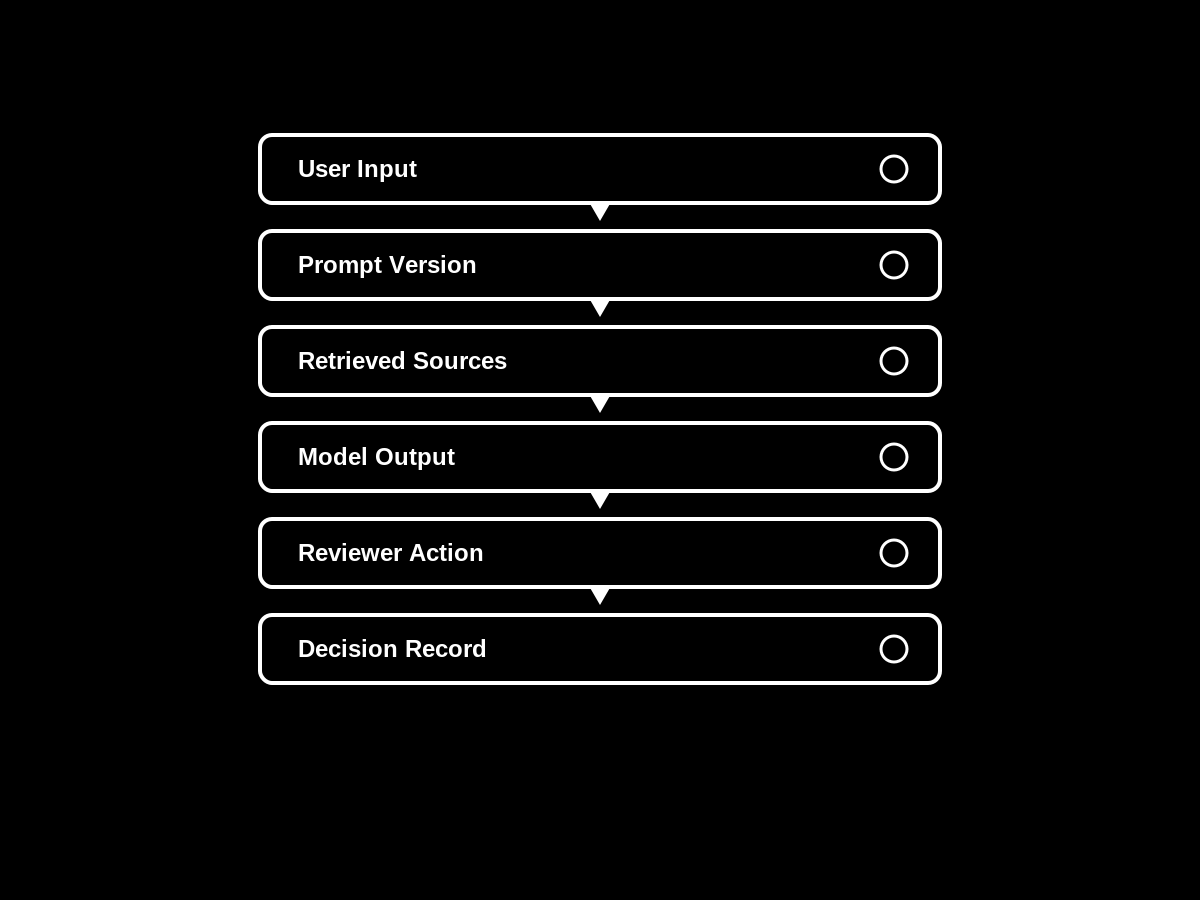
An AI workflow produces useful outputs, but the organization cannot reconstruct what was asked, retrieved, generated, reviewed, logged, escalated, and corrected.
The unauditable output mistake
Scaling AI use faster than an organization can inspect, log, review, and correct it is an expensive mistake. A valuable workflow is unsafe to expand if system inputs, retrieved sources, model versions, reviewer changes, or exception triggers aren't reconstructible.
Why the chain cannot be replayed
AI workflows often lack an operational trust layer. They answer questions but fail to leave a complete record for review.
This is critical in life sciences. An assay answer depends on study design, reagent lot, and normalization. An omics result depends on pipeline version and QC thresholds. If these dependencies aren't logged, the organization trusts outputs without evidence.
Saving only the final prompt and answer is usually insufficient. The critical risk lies between input and output: what documents were available? Which sources were retrieved? Without logging these details, reviewers only see the final result, not the conditions that produced it.
Prompt and model control often fail; users might alter prompts, vendors update models, or parameters change. Unless versions and settings are recorded, reviewers cannot assess underlying conditions.
Review design is another common failure. Reviewers need user questions, retrieved passages, source metadata, model versions, and error flags to assess outputs, not just the final answer.
Exception handling is often immature. The system may fail silently if sources are insufficient or documents conflict. If these states aren't classified and escalated, teams cannot distinguish usable from merely plausible workflows.
Monitoring for life sciences AI workflows must track issues like stale retrieval, prompt edits, reviewer rejection rates, and hallucinated citations. AI adoption outpaces QC architecture; trust needs explicit engineering before scaling.
Restoring traceability
SignalForge defines logging, review, explainability, and QC architecture for bounded life sciences AI workflows.
Work begins by anchoring the workflow to a decision context. This clarifies workflow influence, limitations, and required evidence. We specify what needs capture at each stage: user input, prompt versions, model parameters, retrieved sources (with IDs), tool calls, reviewer actions, and exceptions. The goal is minimal, durable records for inspection and failure diagnosis.
SignalForge distinguishes explainability from mere display. For many workflows, true explanation is reconstructability: showing accessible sources, retrieval methods, assumptions, uncertainties, and human reviewer actions. QC design then defines exception classes, review gates, escalation thresholds, and sampling plans. This includes rules for stale SOPs, missing metadata, conflicting sources, and high-risk routing.
SignalForge complements formal validation and quality assurance by helping teams design the necessary inspection layer before seeking broader organizational trust for scaled AI workflows.
Trace and QC targets
What is recorded: user request, role, use case, permissions, source system, and downstream decision?
Are all prompts versioned and linked to specific outputs?
Can the specific model, version, provider, and runtime parameters for each output be identified?
Are retrieved sources logged with IDs, paths, metadata, retrieval scores, and timestamps?
Can the workflow differentiate between current, superseded, archived, and uncontrolled source materials?
Are summaries, extracted data, tool calls, and agent steps captured if they materially affect the final answer?
Do reviewers have context to challenge outputs, and are actions (approvals, edits, rejections, escalations) recorded?
Are failure states categorized for action, e.g., stale retrieval, insufficient evidence, or suspected hallucination?
Does the team track changes in source corpus, retrieval behavior, reviewer rejection rates, and model updates?
Can the AI output be connected to the specific decision it influenced?
Logging and QC blueprint
A Scan assesses the inspectability of an AI system for scale readiness, producing a workflow-specific trust and QC assessment.
A current state logging map showing what is captured, where it lives, who can access it, and which records are missing.
A reconstruction gap analysis showing whether a reviewer can replay the path from user question, to retrieved sources, to final output, to human decision.
A source traceability assessment covering document IDs, versions, timestamps, metadata, permissions, retrieval records, and stale source risk.
A prompt, model, and parameter control inventory showing which versions are fixed, user editable, vendor controlled, or unrecorded.
A reviewer workflow assessment showing what reviewers see, what they approve, what they change, and where their decisions are logged.
Includes failure classes, severity levels, escalation triggers, and recommended owner roles.
A QC monitoring sketch covering the metrics indicating if the workflow is becoming safer, noisier, stale, misused, or unreliable.
A scale readiness recommendation: scale with controls, repair logging/review, constrain to lower risk, keep manual, or stop the current approach.
A logging retrofit trial
A 2-8 week Pilot can test logging and QC for one bounded workflow, like an internal R&D document assistant. This pilot would verify the workflow’s ability to capture user questions, source corpus, retrieved passages, model versions, final answer, reviewer decisions, and exception flags. Expert-reviewed questions, including edge cases like stale SOPs or conflicting notes, would be tested. The pilot would yield a practical readout: inspectable enough to expand, needs logging/review repair, or should remain constrained.
Trust, retrofit, or retire
This playbook helps leadership determine if an AI workflow is safe to scale, requires repair, should remain manual, or be restricted. This is more useful than asking if the model is "good." A strong model doesn't guarantee a strong workflow, nor do polished demos ensure source traceability. The executive question is whether the organization can detect and correct critical failure modes before the workflow influences more decisions.
This prevents endless debates about AI trustworthiness and costly scaling of ambiguous systems. Without logging and QC, organizations risk expanding usage until an unsupported output damages credibility. With a defined inspection architecture, the path forward becomes clear: expand with controls, repair traceability, narrow the use case, strengthen human review, remain manual, or halt investment. Trust becomes a structured decision system.
Logging and QC FAQ
AI-specific logging must capture evidence, metadata, versions, reviewer actions, and exceptions to allow proper assessment in context.
Not necessarily; this depends on use case, risk, jurisdiction, and quality requirements. This playbook aids in designing inspection and QC for informed regulatory decisions.
Even low-risk workflows need proportionate controls. Logging must match risk, and the organization should know what the tool processed, produced, and how its output was used.
Send this for screening
Send SignalForge one AI workflow you are considering scaling. Include examples of prompts, outputs, source documents, retrieval records, reviewer comments, model logs, and the decision the workflow supports. Most useful are 3-5 real outputs (including questionable ones), the current review process, and leadership's decision objective.