Original pilot claim: What the pilot intended to prove, and how this drifted.
Playbook 12
AI Pilot Rescue & Scale Decision
An AI pilot produced activity but not a clear decision.
The stalled pilot tax
What to stop paying for.
Continuing ambiguous AI activity is an expensive mistake. A stalled pilot becomes a budget sink, adding licenses, cloud use, data engineering, and meetings without clear action. Extending ambiguous AI pilots rarely resolves design flaws.
Why the pilot drifted
The real failure underneath.
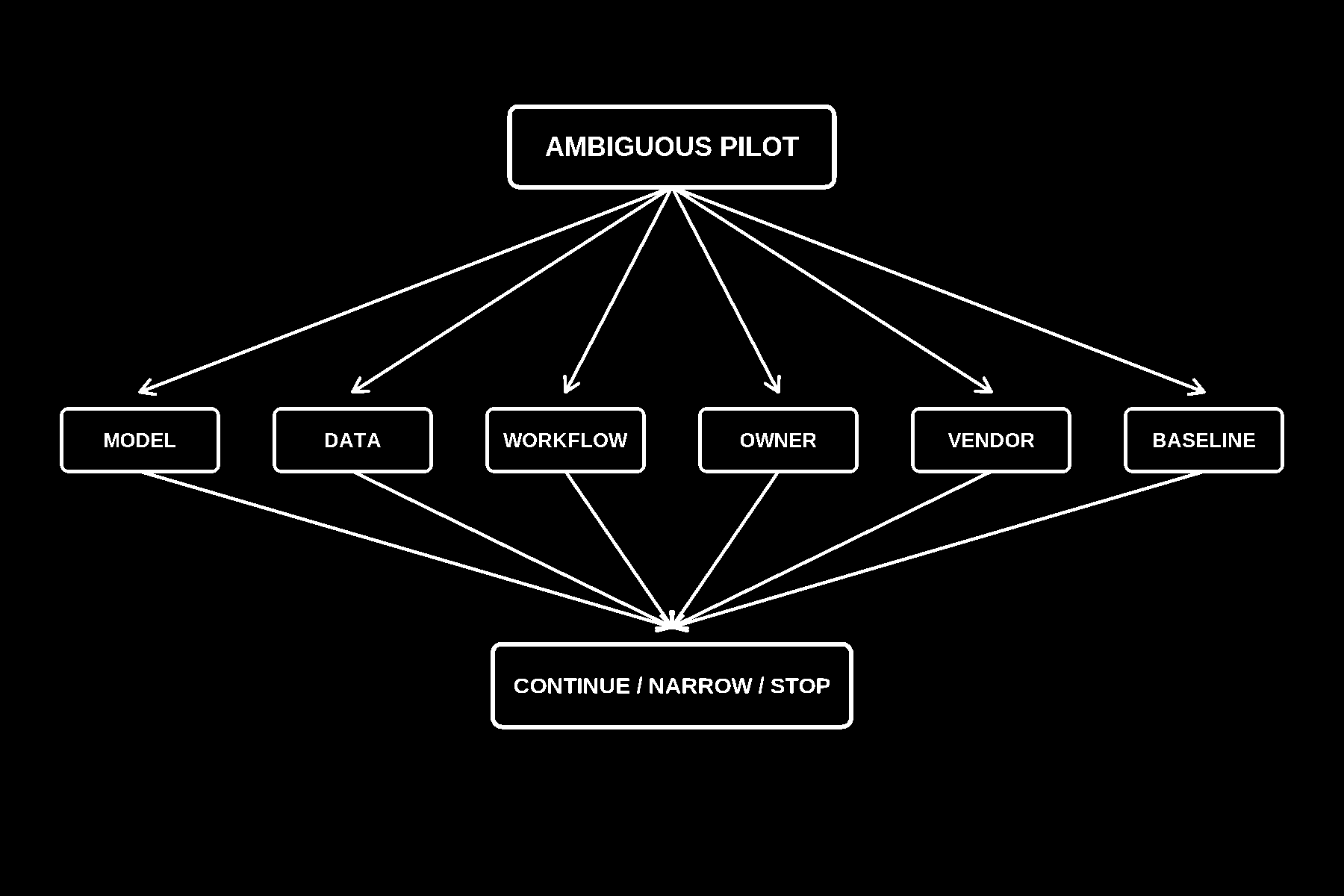
Life sciences AI pilot ambiguity rarely stems from a single cause. By the "should we scale?" stage, multiple failures co-exist: vague promises, uneven data, artificial workflows, inconsistent model behavior, user workarounds, and misaligned vendor assumptions.
Often, the pilot's original target was too broad. A useful pilot must connect to a specific decision or operating judgment, like choosing targets or escalating deviations.
Second, baselines are missing. Without measuring the current workflow, the pilot lacks a counterfactual. If users still verify answers manually, the workflow gains little.
Third, evidence condition. Life sciences data is complex. Assay outputs rely on controls; omics on pipeline versions; documents on ownership. A model appears weak or strong based on data adequacy.
Fourth, workflow realism. Pilots often detach from actual workflows. Users test tools after real work, and vendors get curated files. This misses real friction points like ELN conventions or regulatory sensitivity, revealing an unintegrated system.
Fifth, ownership. Data, configuration, rules, logs, and review gates require clear ownership. Implicit ownership creates temporary coalitions that don't scale.
Sixth, vendor translation. Vendor demos show capabilities under controlled conditions. Pilots test claims against your data, security, and users. Without explicit conditions, pilot readouts devolve into blame.
The result is an uninterpretable pilot. An autopsy must separate technical, evidentiary, operational, commercial, and avoidable issues before further investment.
Rescuing or retiring it
How SignalForge resolves it.
SignalForge resolves AI pilot issues through structured autopsy and decision reset. We gather all pilot artifacts, including scope, proposals, criteria, notes, and costs.
We reconstruct the pilot’s original claim, then inspect evidence against it to understand its purpose.
We separate failure modes: model, data, workflow, ownership, review design, adoption, and vendor mismatches. Each failure implies distinct executive action. SignalForge helps define the next decision: kill, repair, narrow, reframe, challenge, or scale with controls.
Pilot autopsy targets
Where the inspection lands.
Success and stop criteria: Whether measurable thresholds existed for continuation or shutdown.
Baseline workflow: How the task was handled before, including time, quality, and pain points.
Evidence substrate: The condition of source data and documents used in the pilot.
Model and retrieval behavior: System successes, failures, fabrications, or missed context.
Prompt, configuration, and log trail: Traceability from outputs to inputs, settings, and edits.
Workflow fit: Whether the pilot integrated with real-world handoffs and deadlines.
User behavior and adoption: How users interacted with the tool and their trust levels.
Vendor assumptions: Whether vendor claims depended on specific, unstated conditions.
Scale constraints: The likely cost, governance, support, and change management for broad use.
Rescue or retirement memo
What a Scan produces.
A SignalForge Scan for AI Pilot Rescue & Scale Decision produces a focused decision package, typically including:
Pilot autopsy brief
Report summarizing pilot goals, a claim map, failure matrix, baseline gap, data condition, workflow reality, vendor challenge list, scale readiness risk, and a recommended path (kill, repair, narrow, reframe, challenge, or scale), culminating in an executive decision memo.
A re bounded test
What a follow on Pilot would prove.
A bounded 2-8 week rescue pilot can test if an ambiguous AI workflow becomes decision-usable after repair.
For example, SignalForge could narrow a pharma literature intelligence assistant test to one decision: supporting a target opportunity memo with traceable citations and reviewer annotations.
This rescue pilot uses a controlled corpus, defines acceptable error, compares against current workflows, logs interactions, and concludes with a specific scale/repair/stop decision. It tests a single evidence workflow under realistic constraints.
Continue, narrow, or stop
The fork to call.
The main decision is whether to continue funding an AI effort, and in what form. Kill (use case not valuable), repair (data/workflow is limiter), narrow (specific decision is valuable), reframe (wrong objective), challenge vendor (claims unproven), or scale (evidence supports expansion).
This prevents false scale or premature shutdown. An autopsy provides a practical fork: spend more only for clear next moves, stop when ambiguity is structural, repair known bottlenecks, and scale only when validated.
Rescue FAQ
What teams ask first.
What if the pilot already ended months ago?
SignalForge can inspect remaining artifacts: kickoff, readouts, vendor statements, examples, logs, source data, notes, and cost. Gaps then inform the decision to proceed.
What if stakeholders strongly disagree on whether the pilot worked?
Disagreement often means varied success definitions. SignalForge clarifies these criteria, enabling informed leadership decisions.
Does this replace validation, quality, legal, clinical, regulatory, or compliance review?
No. SignalForge interprets pilot evidence and identifies failure modes, advising on AI investment before formal validation or compliance processes.
What to send for review
Rescue worthy material for the screen.
Send the pilot readout, original scope, success criteria, example outputs, user feedback, model logs (if available), source data description, review notes, cost, and the decision requested from leadership. The core question: "What should we do next, supported by what evidence?"