Decision question
Playbook 14
Decision Grade Evidence Memos
Leadership needs a recommendation, not another evidence dump.
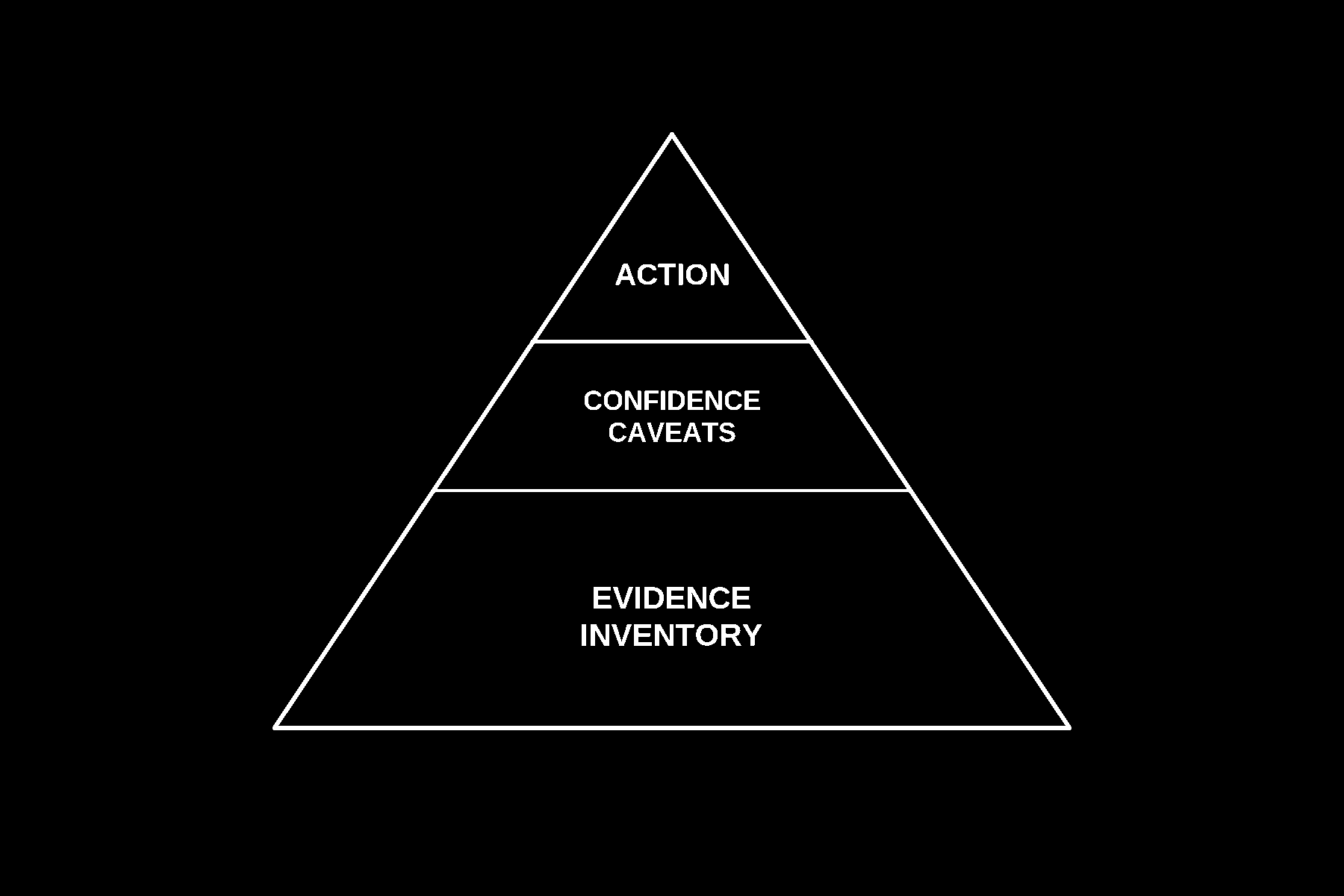
The evidence dump habit
What to stop producing.
Excessive technical detail hinders decision-making. More data often obscures, rather than clarifies. A memo lacking a clear question, source confidence, supported claims, caveats, options, recommendation, risk, and action indicates a judgment structure deficit.
Why memos fail to decide
The structural break.
Teams collect information faster than they organize decisions. Executive questions go unaddressed. A translational group has assay results, an AI team has vendor demos, but neither forms a decision.
The first break: no precise decision question. "Evaluate platform" fails; "Fund a six-week pilot for platform XYZ to reduce triage time in target ID review without violating data access?" succeeds. Evidence lacks focus without a clear question.
The second break: source authority. Internal data, vendor claims, papers, and informal interpretations are often treated equally, despite varying credibility. This blurs source confidence and hides unapproved assumptions.
The third break: poor uncertainty handling. Uncertainty is either buried or causes analysis paralysis. Neither supports good decisions. Leadership needs to know which uncertainties matter, are tolerable, and could alter the decision.
The fourth break: conflating signal with actionability. An accurate model might fail in a workflow due to permissions. Biologically interesting results might not justify validation. An impressive demo could be fragile. Promising evidence is not always evidence for immediate action.
The fifth break: recommendation avoidance. Technical teams hesitate to recommend. This is costly, as executive decisions rarely rely on complete evidence. A strong memo states the best option, risks, assumptions, and what invalidates the recommendation.
The final break: unchallengeable memos. A good memo invites scrutiny: Which source is weakest? Which assumption is critical? What alternative was rejected? Re-examining all raw evidence for these questions means the memo is insufficient.
Engineering decision grade memos
How SignalForge tightens the format.
SignalForge transforms scattered evidence into executive memos that facilitate decisions. We define the specific decision—e.g., funding a pilot, continuing a program, stopping a project—framing it operationally with owner, timeline, evidence, and constraints.
SignalForge reviews all evidence—assay contexts, ELN notes, omics assumptions, vendor decks, patents, diligence notes—to isolate only what directly impacts the decision. Evidence is organized by confidence and relevance, distinguishing internal experiments from exploratory analyses, vendor claims from verified results, and expert judgment from measured data. Caveats are explicit, unsupported claims flagged, and assumptions/risks tied to decisions.
The memo structures options: proceed with a pilot, pause for data, reject the vendor, fund validation. Each option links to evidence, uncertainty, delay costs, and risk acceptance.
SignalForge supports this via Scan → Pilot → Run. A Scan assesses evidence readiness. A Pilot converts one decision workflow into a repeatable memo format (2-8 weeks). Run maintains a senior cadence for recurring decisions. SignalForge structures evidence and judgment for informed decision-making; it does not replace regulated validation, legal advice, or clinical judgment.
Memo inspection points
Where review begins.
Anchored to a specific decision, owner, timeline, and action.
Evidence inventory
Identifies experiments, analyses, documents, model outputs, and expert inputs.
Source confidence
Classifies each source by credibility, proximity, origin, validation, and limitations.
Assay and experimental context
Inspects controls, sample handling, QC notes, and protocol deviations.
Computational and omics lineage
Reviews pipelines, parameters, genome builds, and batch corrections.
Vendor and third party claims
Separates vendor claims from organizationally verified results.
Unsupported assertions
Marks statements lacking adequate evidence.
Caveats and uncertainty
Integrates known limitations, noting those that alter the recommendation.
Options and rejected alternatives
Explains available choices and reasons for rejected paths.
Recommended action and risk acceptance
States recommended step, accepted risk, and consequences of delay.
Memo standards and templates
What a Scan produces.
A Decision Grade Evidence Memo Scan yields concrete artifacts like:
Decision question
A written decision question with owner, deadline, scope. An evidence inventory with confidence, and missing artifacts. A source confidence map. A caveat register. A signal vs. speculation table. Decision options. A recommendation outline, with risks and next actions. Critical evidence gaps. A memo skeleton. A pilot or stop recommendation for insufficient evidence.
A memo format trial
What a Pilot would prove.
A 2-8 week pilot tests one recurring decision memo workflow.
SignalForge could help an AI/data or translational team convert an evidence package into a decision-grade memo. This might assess funding an internal AI tool. SignalForge would inspect evidence, identify claims, separate data from model-generated summaries, define review gates, draft the executive recommendation, and product a clear memo on whether to proceed, narrow, test, or stop.
The pilot aims to prove if a high-value decision can be clarified using a repeatable memo structure.
Adopt, revise, or shelve
The leadership fork.
This playbook helps leadership assess current evidence. Executives need actionable guidance, not speculation. They need to know what's supported, what's not, and what action is justified despite uncertainty. This distinction is crucial; life science organizations waste resources between "interesting" and "decision ready." A memo stating source confidence, caveats, options, and risk allows executives to act without overstating evidence clarity.
Practical choices are stark: proceed or stop spending; fund validation or demand better controls; advance BD or reject unverified claims. A decision-grade memo guards against costly failures like overconfidence and delayed action. It provides a recommendation leadership can challenge, modify, accept, or reject without re-examining raw data.
Memo FAQ
What reviewers ask.
Can SignalForge write the memo for us?
SignalForge structures, drafts, and refines memos. The organizational owner is accountable. Regulated contexts still require reviews.
What if the evidence is too incomplete to recommend anything?
This is a valid finding. A strong memo can recommend not proceeding, narrowing, testing, or rejecting claims. "Insufficient evidence" is useful only when it details what's missing, its importance, and next steps.
Is this just executive ghostwriting?
No. Writing is the final step. The core work is evidence triage: clarifying questions, ranking confidence, separating fact from speculation, detailing caveats, identifying unsupported claims, and linking options to risk. A polished memo lacking this structure is still an evidence dump.
Send a sample memo
What to share so the format can be assessed.
Send SignalForge one decision that is stuck, urgent, or politically difficult.
Provide the current deck or memo, decision deadline, desired owner, relevant summaries, vendor materials, model outputs, prompt logs, SOPs, document inventories, publications, patents, diligence notes, and stakeholder disagreements.
SignalForge will assess if the evidence supports a decision-grade memo, identify missing structure, and recommend a Scan, Pilot, or stop.