Sample and assay provenance
SignalForge inspects whether sample IDs, assay batches, controls, and exclusions connect from wet lab to computational inputs.
Playbook 04
The figure, table, feature matrix, or model input is easier to find than the computational path that produced it.
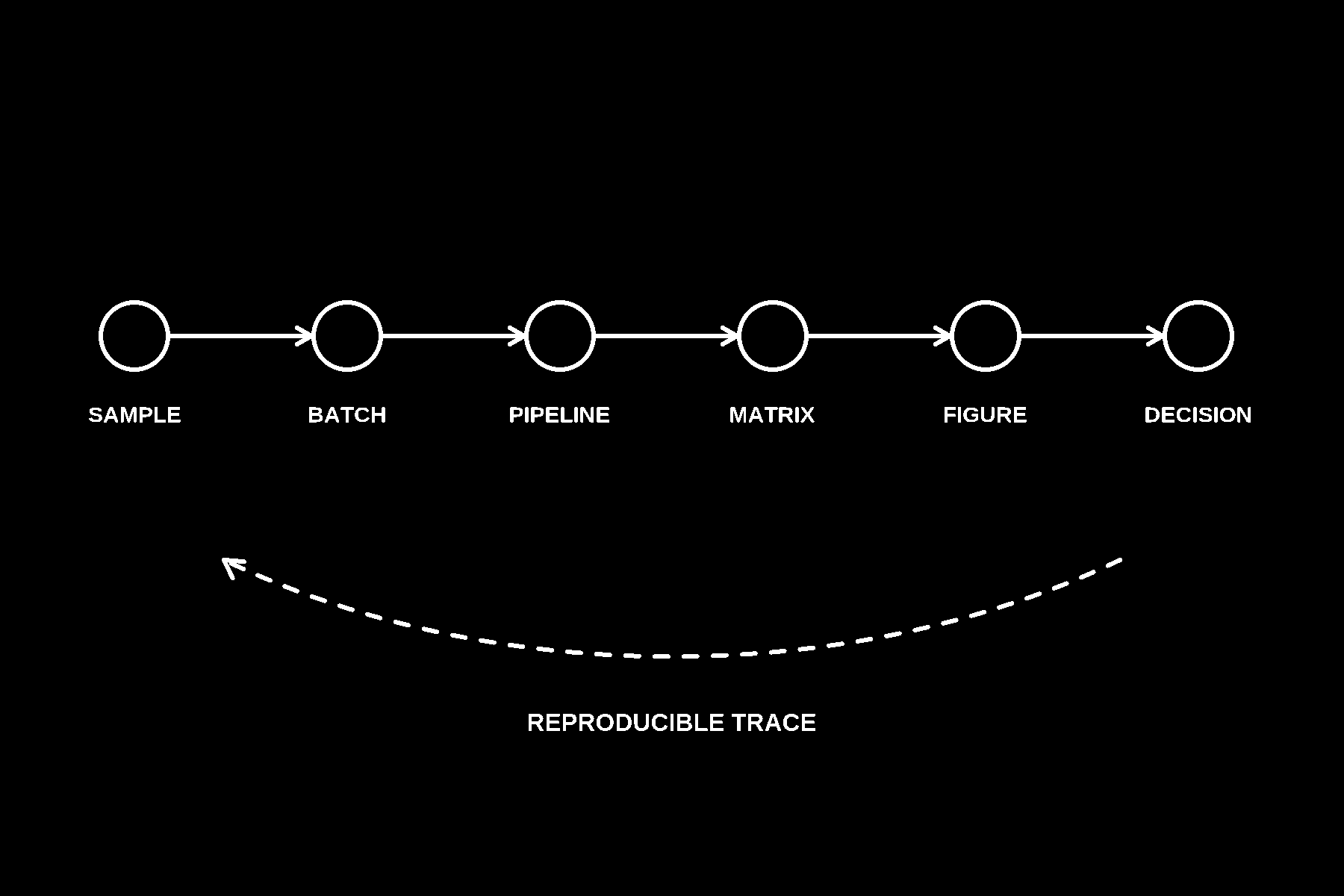
The figure without chain mistake
The expensive mistake: a result like a heatmap or biomarker table lacks a clear computational path. If the team can't reconstruct sample manifests, assay context, pipeline versions, or filtering thresholds, the result is costly to reuse and risky to trust.
Why the path disappears
Omics work spans wet lab, computational, and translational teams, fracturing evidence paths. Sample tracking disconnects from transformed data like FASTQ or VCFs by the time results appear. Reviewers see "Responder vs. Non responder signature" without the underlying transformations that made it possible.
Computational assumptions like reference genome builds, annotation versions, and filtering thresholds significantly impact interpretation. Even minor differences can alter feature tables used for models, claims, or patents.
Feature construction is particularly vulnerable. Teams describe "inflammation score" but struggle to show the exact recipe: raw or normalized counts, filtered genes, batch correction?
Notebook analysis, while exploratory, often lacks parameters or cloud job details. The needed lineage depends on the decision's stakes. Brittle handoffs where assay context, parameters, and intermediate results are separated make reconstruction difficult, relying on hidden individual knowledge.
Rebuilding the chain
SignalForge traces the entire path from sample to decision, identifying fragility and hidden assumptions.
In a Scan, SignalForge reviews the evidence chain to identify strong or fragile lineage, hidden assumptions, and decision readiness. This examines manifests, assay metadata, pipeline repositories, cloud records, notebooks, feature construction, and final artifacts.
In a Pilot, SignalForge tests a bounded workflow—e.g., reconstructing an RNA-seq signature—to learn logging, versioning, or review needs before scaling. This proves a pattern, not a complete overhaul.
In Run, SignalForge provides ongoing support for recurring AI/data and computational evidence workflows, including evidence chain reviews and risk tracking. SignalForge clarifies computational and evidence risks for leaders to make informed decisions.
Evidence chain targets
SignalForge inspects whether sample IDs, assay batches, controls, and exclusions connect from wet lab to computational inputs.
SignalForge checks if genome builds, pathway databases, and other reference files are recorded and linked to outputs.
SignalForge inspects whether pipeline code, workflow versions, containers, cloud jobs, and input manifests are preserved.
SignalForge examines if thresholds, filtering rules, normalization options, and model parameters are explicit.
SignalForge checks if key intermediate files like count matrices, QC summaries, and filtered tables are retained and traceable.
SignalForge inspects how biological features are built, including transformations, aggregation, and handling of missingness or outliers.
SignalForge examines whether excluded samples, failed runs, and manual overrides have documented rationale.
SignalForge inspects whether notebooks and scripts can be rerun without hidden paths or stale objects.
SignalForge checks if final figures and tables link back to their computational origins.
SignalForge inspects how computational outputs move into discussions and whether caveats are preserved.
Chain reconstruction memo
A Scan produces an evidence chain map detailing how outputs flow from sample to decision. It identifies lineage gaps and assesses whether current outputs are decision-ready, repairable, reusable, or unreliable.
The diagnostic also produces a lineage gap register covering missing sample links, undocumented reference builds, weak parameter capture, unclear filtering logic, fragile notebook dependencies, missing intermediate outputs, undocumented exclusions, and unreviewed feature construction steps.
SignalForge provides a decision readiness assessment for the target output: decision ready, repairable, reusable with controls, suitable for a bounded AI pilot, or untrustworthy without a full rebuild.
The Scan pinpoints minimum logging, versioning, and review steps needed for reuse, including parameter templates, run manifests, and cloud log retention.
Finally, the Scan recommends a pilot or stop, advising whether to harden a workflow, reconstruct an output, or avoid building models on untrusted computational artifacts.
A re derivation trial
A 2-8 week Pilot tests if one omics-derived feature table can be made reusable for modeling. For example, SignalForge reconstructs an RNA-seq signature, documenting the full path. The Pilot proves if a qualified reviewer can follow, reproduce, and deem the feature table safe for an AI pilot or biomarker review. The outcome is a proven workflow pattern, identifying what can be reused, repaired, or not trusted beyond exploratory contexts.
Trust, rebuild, or retire
This playbook helps leadership determine if an omics or computational output is truly ready for future decisions. Without a robust computational evidence chain, leaders face a false dilemma: blindly trust a figure or reject output due to unclear lineage. A better approach separates biological plausibility from computational readiness.
Avoiding bad spend is crucial. Teams waste months building models on unstable data or repeating analyses due to distrust. The core choice is: repair the chain, reuse with limits, run a focused pilot, or stop entirely. SignalForge clarifies this fork, preventing investments in fragile computational foundations.
Omics evidence FAQ
No, the required standard depends on the decision. Explicitly defining the necessary level is key.
Not inherently. This playbook traces specific computational evidence paths, a narrower and more actionable focus than broad data governance.
Often, yes. SignalForge assesses minimum reconstruction. Some outputs can be repaired; others remain exploratory until rebuilt.
Send this for the screen
Send SignalForge one representative omics or computational output (e.g., figure, feature table), plus supporting documentation (e.g., manifests, logs, decision context). SignalForge will assess if the problem is lineage, reproducibility, feature construction, or AI readiness.