Decision being supported
What specific decision changes because of the output, and who makes it?
Playbook 06
Teams are debating model classes before proving what the decision actually requires.
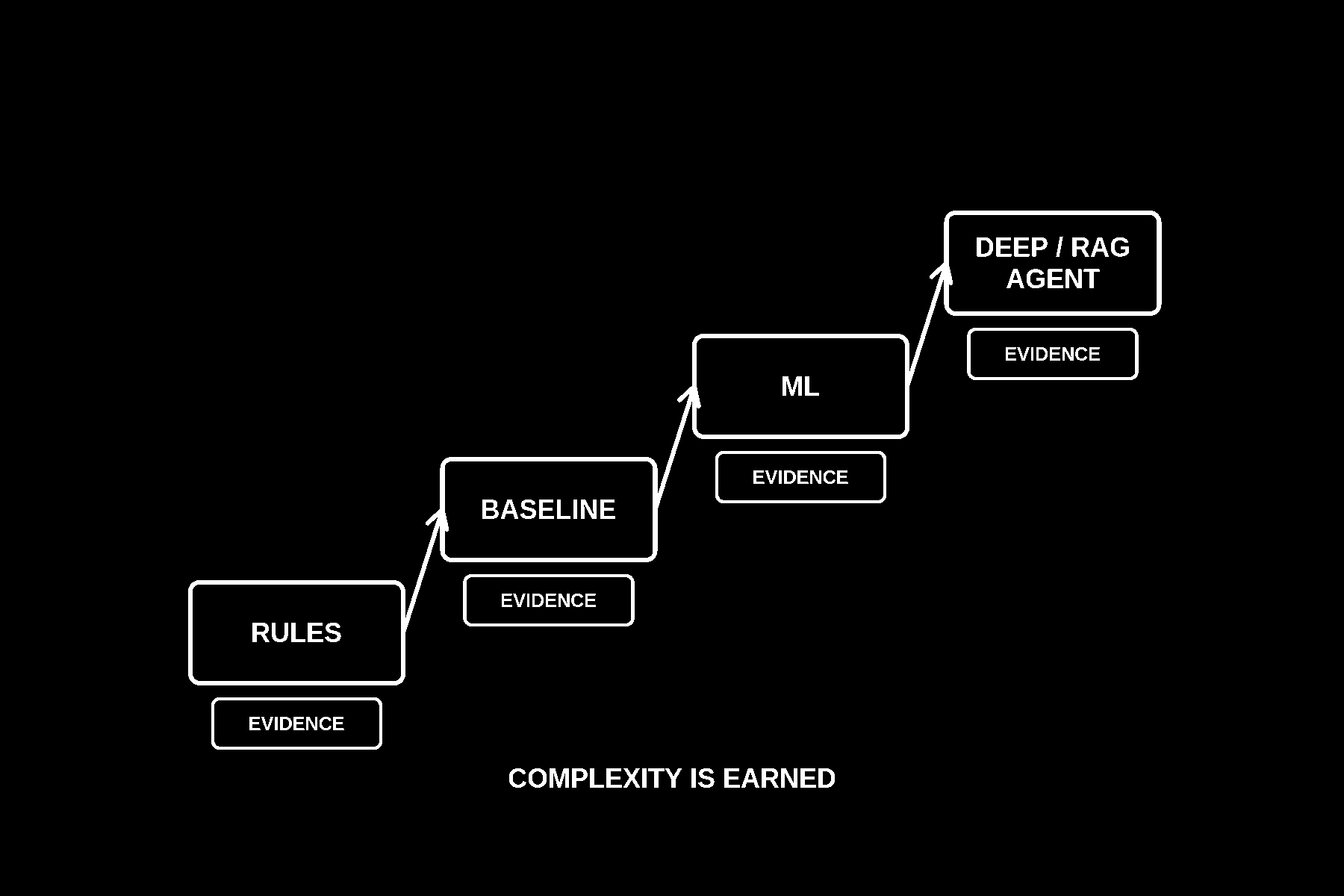
The class debate mistake
The mistake is choosing a model class before proving what the decision requires. This often means buying complexity early, like deep learning when rules suffice, or a vendor platform without understanding internal labeling and review processes. The cost is not just software, but months spent on unsuited methods.
Why the wrong class wins
Model selection is often framed as an architecture question (e.g., classical ML vs. deep learning, RAG, agents) rather than starting with: what decision does this system improve, and what evidence is needed? Life science workflows have distinct computational needs.
Target definitions are often vague. Terms like "success," "risk," or "quality" can collapse multiple judgments. A model cannot clarify an undefined target.
Data shape constraints are often ignored. Problems vary from structured tables to sparse labels or inconsistent documents. The method must be constrained by available data, not preferred demos.
Review burden is critical. Outputs require validation for source grounding, reproducibility, and safety. Agentic systems require robust permission design, logging, and rollback.
Escalation discipline is key. Sophisticated methods can be appropriate, but each escalation must be earned. The question is "what unique decision value justifies added complexity?" not "can we use a more advanced model?"
Anchoring the selection
SignalForge treats model selection as a decision, evidence, workflow, and operational burden problem. We decompose "AI" use cases into task types: prediction, classification, ranking, retrieval, summarization, extraction, anomaly detection, routing, or agentic action. Each task has different data, testing, review, and maintenance implications.
In a Scan, SignalForge examines the decision, evidence, target definition, data shape, label source, and review burden. The goal is to identify the simplest defensible computational approach and the evidence needed to justify complexity. Recommendations might be "start with rules," "test retrieval before fine-tuning," or "this is a workflow ownership issue."
In a Pilot, SignalForge tests a bounded method under real conditions, comparing options like expert rules or a classical ML baseline on actual assay investigations. The emphasis is on decision usefulness given source constraints, permissions, review expectations, and maintenance realities.
In Run, SignalForge provides ongoing advisory to manage method creep, untested vendor claims, and data drift.
Selection pressure points
What specific decision changes because of the output, and who makes it?
Is the real task prediction, classification, ranking, retrieval, summarization, extraction, anomaly detection, routing, or automation?
Are labels like “risk” or “quality” operationally defined, consistently applied, and tied to a decision?
Are inputs structured tables, omics matrices, ELN notes, documents, images, or mixed sources?
How many usable examples exist, who labeled them, and what changed over time?
Could thresholds, rules, control charts, descriptive analytics, or search solve enough of the problem?
Does the reviewer need a reason code, source citation, feature contribution, or audit trail?
Who will refresh data, monitor drift, update prompts, review edge cases, and manage permissions?
Where does the output enter the process, and what human review, exception handling, and logging steps are required?
Does tool's evidence, integration, data handling, and configurability match the use case?
Selection memo
A Model Selection Brief stating the decision, task type, candidate methods, and recommended starting point.
A data shape and label quality assessment covering sources, records, target ambiguity, metadata, and bias risk.
A baseline first test plan identifying what rules, statistics, or classical models should be tested before advanced methods.
A complexity escalation ladder showing what evidence justifies moving from rules to analytics, or from ML to deep learning.
A review burden assessment covering interpretability, source grounding, logging, permissions, and exception handling.
Includes cases where SignalForge advises no model until the decision or data substrate is repaired.
A head to head trial
A 4-6 week Pilot could compare expert rules, statistical anomaly screens, and a classification model for an assay investigation workflow, using real ELN exports and reviewer decisions. The goal is to determine which method provides reviewers with sufficient signal, explanation, reproducibility, and operational value.
Adopt, defer, or replace
This playbook enables method choice decisions before committing budget, vendor dependency, or operational burden. The decision shifts from "Which AI architecture?" to "What is the simplest system that improves this decision without avoidable risk?"
It also prevents misdirected spend. Complexity carries high costs. A disciplined model selection check reveals if clearer target definition, cleaner metadata, a retrieval workflow, or vendor diligence is a better investment. It also provides evidence to defend advanced modeling when justified.
Model selection FAQ
State what the method would need to prove: decision improvement, baseline beaten, data required, acceptable errors, review burden, and maintenance demands.
No, advanced methods are appropriate when problem structure, evidence volume, data quality, and operational value support them; the issue is premature escalation.
A demo shows technical possibility, but a sanity check determines if the vendor method fits the buyer’s actual data, workflow, and decision criteria.
Send this for screening
Send SignalForge the current AI use case, any vendor proposals, sample data, target definition, desired outputs, and the decision memo the output supports. Useful materials include assay context, ELN exports, SOP excerpts, metadata, dashboard screenshots, and prior baseline results.