Target outcome definition
Inspects if the label reflects the actual decision, not just a convenient database field.
Playbook 07
A team claims model performance but cannot say what the model beats.
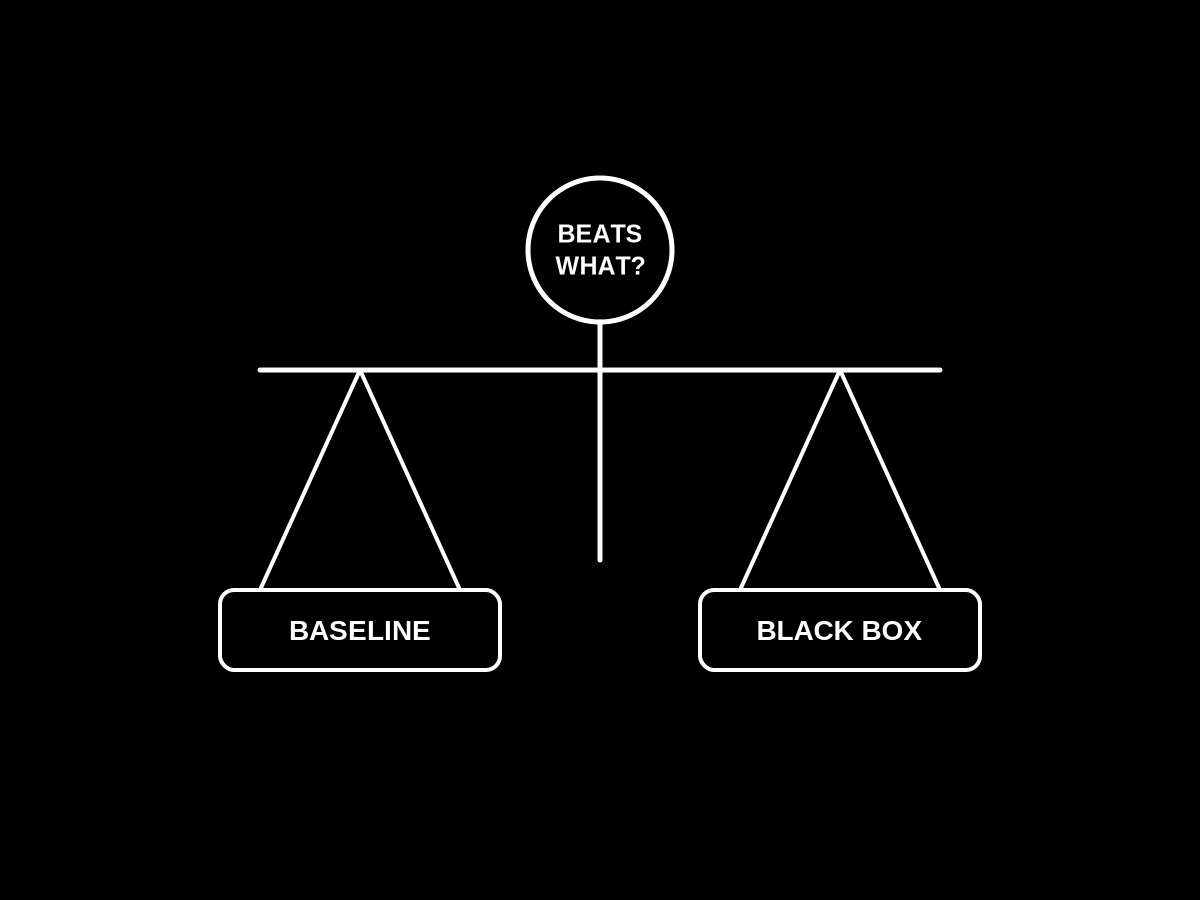
The complexity before baseline mistake
Approving black-box complexity before a transparent reference point is expensive. Teams invest in tools, compute, or vendors around a model unproven against a rule, statistic, or basic baseline. Complexity obscures risk.
Why there is no reference point
Life sciences AI often fails because teams improve advanced models without an established comparison. A model may predict assay success, but if the target is unstable, it optimizes the wrong label. "Responder" may mean different things across translational analysis, clinical databases, and governance.
Leakage, where models learn from future information or operational proxies, is another failure. A model might learn a study identifier instead of biological signal. Confounding identifies real patterns irrelevant to the decision, e.g., separating cohorts by site, not disease. Sampling bias further complicates this, as life sciences datasets are collections of funded or measured data, not neutral representations. A black box model can internalize organizational blind spots.
Small data also impacts complex modeling. Without sufficient high-quality labeled examples, the immediate need may be target repair, not complex architectures. Baselines are crucial: a rule, threshold, statistical model, or existing workflow. The baseline must show if an advanced model adds incremental value. Without it, teams cannot discern signal from artifact, justify compute, or explain model lift. The baseline enforces decision discipline.
Establishing the comparator
SignalForge defines target outcomes, clarifying decision logic. For an assay, this differentiates "technically failed" from "biologically uninformative." For omics, it clarifies if the model addresses biomarker discovery or target prioritization. Once clear, SignalForge maps features, identifies leakage risks, and specifies the minimum viable dataset, preventing unfair model advantages.
SignalForge builds robust baselines from transparent rules, existing logic, or simple models for fair comparison. Benchmark metrics are chosen based on operating decisions, like sensitivity at required specificity or value in reducing unnecessary repeats, not generic accuracy. We define escalation criteria: when is a baseline sufficient, when is advanced modeling justified, or when should data or targets be redefined? SignalForge ensures model decisions are inspectable through Scan, Pilot, and Run.
Baseline pressure points
Inspects if the label reflects the actual decision, not just a convenient database field.
Checks which variables are available at decision time versus those that leak future knowledge.
Identifies simple rules, statistical models, and existing workflows the advanced model must beat.
Assesses if sample counts and subgroups support the proposed model class.
Inspects assay context, instrument IDs, protocol versions, and document sources.
Identifies study ID, batch, site, or post-decision fields that might falsely flatter performance.
Assesses if performance is tested across meaningful boundaries like time, study, or site.
Inspects if reported metrics align with the costs of errors or review burdens.
Checks if the team defined the score cutoff where the model changes behavior.
Inspects whether model outputs, assumptions, and reviewer overrides are reconstructible.
Baseline readiness memo
A Baseline Readiness Memo summarizes target outcomes, decision context, model claims, open questions, and go/no-go concerns.
Concise overview of model readiness and key considerations.
Details current vs. testable definitions for outcomes.
Identifies data points that may artificially inflate model performance.
Outlines essential data requirements for fair comparison.
Defines transparent comparators for measuring advanced model value.
Connects performance metrics directly to operational decisions.
Guides when to escalate to advanced models, remediate data, or redefine targets.
Advises on proceeding with a pilot, data remediation, or pausing the initiative.
A baseline vs model test
A 2-8 week pilot benchmarks an advanced biomarker response model against transparent comparators in one translational workflow. This selects one indication, assay, target, and decision point. SignalForge defines the label, freezes the dataset, quarantines leakage-prone fields, and compares the advanced model against agreed baselines (e.g., logistic regression or existing rubric).
The goal is to determine if the advanced model adds decision-relevant lift under fair splits, meaningful metrics, reviewer inspection, and decision-time feature constraints, not immediate production.
Fund, refit, or stop
This playbook determines if advanced modeling justifies its complexity or if an organization funds an abstraction over weak evidence. Leadership needs to know if the approach beats a defensible baseline at the action-changing threshold. If so, invest further. If not, avoid scaling fragile systems that perform well only due to leakage, confounding, or irrelevant metrics.
Advance the model if it adds unique signal, repair the data substrate, or adopt the transparent baseline as the operating workflow if sufficient and cheaper. The latter isn't an AI strategy failure but a disciplined allocation decision, stopping investment before complexity proves its value.
Baseline FAQ
No, a baseline is a control condition to prove if complex models add value, even for multi-modal, high-dimensional signals.
Vendor claims must be evaluated against your specific data constraints, operating thresholds, and review processes; demo performance may not translate to internal conditions.
If the baseline suffices, the organization can use it, improve it, and reserve advanced modeling for problems where the baseline falls short, saving costs and enabling easier review.
Send this to begin
Send SignalForge your model claim, target outcome, feature list, reported metrics, train/test split, metadata, and the decision the model supports. Useful materials include assay summaries, ELN/LIMS exports, SOPs, prompt/model logs, and vendor demo outputs.