Decision target
What specific decision will the AI system improve?
Playbook 01
AI roadmap pressure outpaces decision clarity. The first problem is defining the decision, owner, evidence, review burden, and next step so leadership can fund, fix, defer, or stop work responsibly.
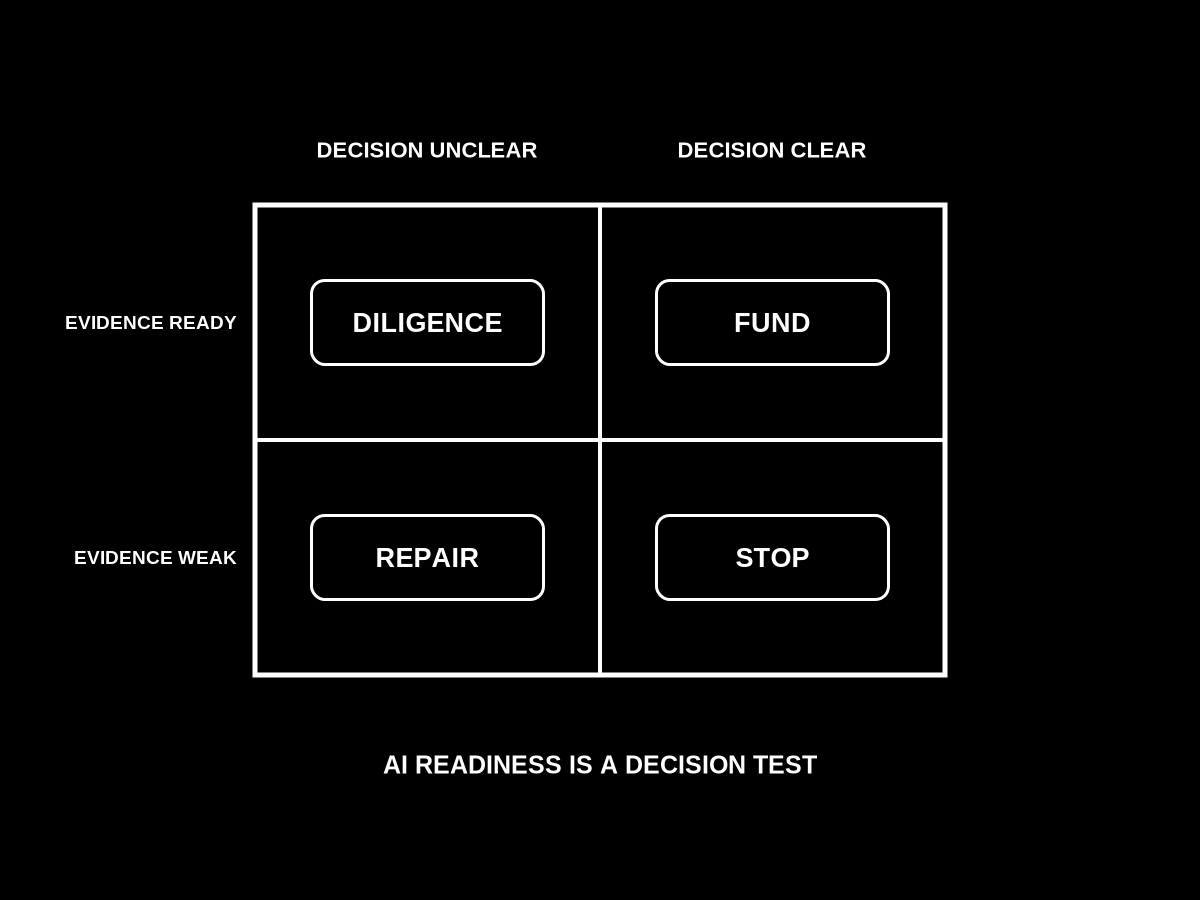
The roadmap before problem mistake
Funding AI without clear problem definition leads to demos and prototypes before clarifying ownership, evidence, risk, and stop rules. The predictable result: every idea seems strategic, every pilot promising, yet no clear path for funding, fixing, deferring, or stopping projects.
Why the roadmap floats
Organizations often use "AI roadmap" to mask unresolved decisions. This combines distinct questions: workflow priority, evidence authority, ownership, user action, risk, utility, and stop criteria. Without clear definitions, every AI idea appears reasonable.
Different AI applications use diverse evidence, carry unique risks, and demand distinct review paths. An AI system summarizing publications has a different burden than one recommending experiments from noisy assay data. An internal SOP assistant differs from an agent drafting regulated responses. Without distinguishing these, a "roadmap" becomes an unresolved decision queue.
Ambiguity often leads to technical requests, but the core issue is the operating definition of the decision. Vendor demos exacerbate this by making ambiguous problems seem solvable with staged tasks. Such demos don't prove systems can handle messy internal evidence, permissions, and review gates. Ultimately, leadership fails to categorize AI ideas: some are fundable, some need data repair, some require vendor diligence, and others should be deferred or rejected. Problem definition ensures explicit categorization before spend accelerates.
Defining the first problem
SignalForge converts broad AI pressure into a structured decision inventory by separating enthusiasm from operating reality. Each use case is examined through a life sciences lens: decision, owner, evidence, metadata gaps, review burden, risk, and whether it warrants funding, fixing, deferring, diligence, or rejection.
The goal is a clear executive fork, not a generic AI roadmap. Some ideas are ready for a Scan. Others need substrate repair. Some require vendor diligence, while others should be stopped because they lack a decision owner. SignalForge follows a Scan → Pilot → Run model, ensuring not every idea proceeds identically. The first step isn't just "more AI"; it's making the use case portfolio legible for responsible leadership decisions.
Readiness pressure points
What specific decision will the AI system improve?
Who is accountable for acting on or rejecting the output?
Which records, files, databases, or documents are authoritative?
Where does the evidence reside today (e.g., ELNs, LIMS, SharePoint)?
Is sample, reagent, instrument, and QC data sufficient for interpretation?
How will the AI output integrate into the existing human workflow?
Who reviews the output, by what standard, and is the review efficient?
Is the use case exploratory, operational, regulated, or sensitive?
Are vendor claims assessed against internal evidence and constraints?
What measurable results justify further investment or cessation of work?
Readiness memo
For this playbook, the Scan output includes a decision inventory of candidate AI use cases, organized by decision type, owner, evidence source, workflow, review burden, and readiness.
Triage view categorizing use cases as fundable, fixable, diligence required, deferred, or rejectable.
Evidence map showing locations of relevant materials (e.g., ELNs, SharePoint, SOPs, CRO outputs).
Owner and reviewer map detailing who generates, inspects, approves, or acts on AI outputs.
Readiness gap list identifying issues in metadata, permissions, workflow integration, and risk.
First move recommendation: proceed to Pilot, repair substrate, conduct vendor diligence, defer, or stop the idea.
A first problem trial
A 2-8 week Pilot could test one decision workflow, such as AI-supported triage for assay troubleshooting in a discovery biology team.
This Pilot would not attempt enterprise-wide "AI readiness," but rather focus on one assay family, evidence set, owner, and review path. The test assesses system ability to assemble context, preserve provenance, expose uncertainty, support scientific review, and enable decision-making. Success and failure criteria would be predefined.
Fund, narrow, or stop
This playbook enables critical executive decisions: which AI idea deserves the next investment. It shifts focus from excitement or vendor demos to whether an AI effort is ready for inspection, needs evidence repair, requires vendor diligence, should be deferred, or rejected. This approach prevents funding activity that generates motion without operating clarity.
This clarity avoids wasteful spending on platforms, pilots without stop criteria, or vendor comparisons before evidence constraints are set. A practical readiness view allows leadership to sequence the portfolio responsibly. Some use cases can proceed, others require repair, some need diligence, and some can be stopped. Leadership gains a clear framework to say yes, not yet, buy carefully, repair first, or no.
Readiness FAQ
Yes, if your roadmap lists ideas rather than sequencing decisions; a useful roadmap prioritizes use cases ready for inspection or needing repair.
No, this focuses on decision readiness; modern infrastructure doesn't guarantee the evidence provenance, ownership, or stop criteria needed for responsible AI.
No, SignalForge clarifies decisions, evidence, and risks so internal authorities can evaluate the work; regulated validation and legal decisions remain with accountable teams.
Send this to begin
Send SignalForge your current AI roadmap, use case list, vendor shortlist, pilot list, or strategy memo causing ambiguity. Include proposed use cases, target users, evidence sources, expected decisions, data gaps, platform constraints, and executive questions.
A useful starting packet includes: one roadmap slide, three candidate use cases, a workflow diagram, evidence locations, vendor demo notes, and the key decision leadership struggles with.