Historical evidence classes
SignalForge segments archives into classes (e.g., assay series, omics runs) based on reuse rules.
Playbook 05
Years of historical data exist, but no one can say which records are usable, trustworthy, repairable, or relevant to a current decision.
The legacy archive trap
Broad archive cleanup or AI ingestion programs are expensive mistakes. Old records rarely become decision-grade just by centralization; many remain ambiguous or too costly to repair. Identify which historical evidence could change a current decision, assess repair costs, and compare to generating new evidence.
Why old data resists reuse
Historical data is a mixed archive, not a single asset. Some records hold high-value signal (e.g., well-controlled assays, omics data with lineage, CRO study packages), while others are expensive noise. Treating all historical data as equally cleanable is a mistake; every archive has distinct evidence classes.
Provenance breaks occur from identifier drift (compound, sample names change across systems) or lost context (final outputs without production details). AI tools interrogate and summarize archives but don't restore missing metadata or validate labels, potentially laundering weak evidence into confident recommendations.
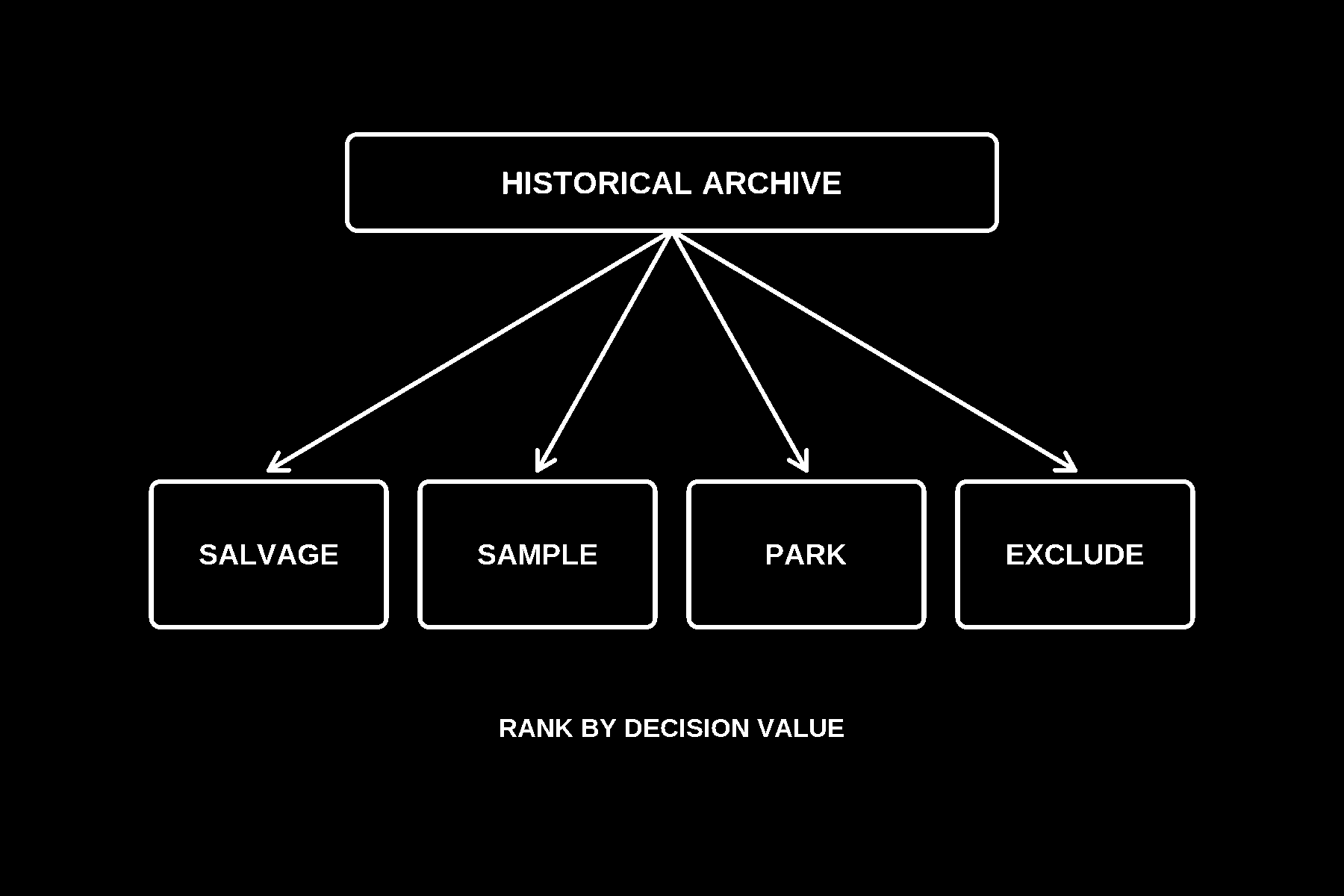
The practical question is: "Which slice of historical evidence can support a current decision if repaired, and what repair is required?" This shifts focus from full archive cleaning to ranking segments by decision value, scientific relevance, metadata sufficiency, and rescue cost. Some records are promoted for reuse, others sampled, some preserved for narrative history, and some excluded from AI claims.
Triaging the archive
SignalForge treats historical data rescue as archive triage, anchored by a specific current decision. We inventory major historical evidence classes (e.g., assay records, omics outputs) and assess each for reuse value, metadata completeness, provenance, identifier stability, and repair burden.
Emphasis is on ranking records, separating those plausible for current decisions from those better for historical reference or too costly. If promising, we define a narrow rescue path: critical fields, necessary joins, human review, reconstructible metadata, and safe AI applications.
In a Pilot, SignalForge tests a bounded reuse case with actual files. This verifies if an archive slice can be repaired to impact a decision. In Run, SignalForge maintains oversight across rescued evidence, metadata rules, and AI tooling.
Archive triage targets
SignalForge segments archives into classes (e.g., assay series, omics runs) based on reuse rules.
Each segment is tested against a live decision to assess its impact on prioritization, assay selection, or AI feasibility.
SignalForge checks if records preserve essential reuse fields (sample identity, protocol, QC status).
The review traces the data path from raw evidence to interpretation, including exclusions and transformations.
SignalForge assesses if entities (compounds, samples) reliably match across systems.
Records are checked for controls, batch behavior, and outlier handling to validate old conclusions.
SignalForge evaluates if archived data can join current master data and registries.
Each candidate archive slice is scored for manual review, metadata reconstruction, and owner consultation.
SignalForge inspects AI suitability and identifies where AI might create false confidence.
Inspection identifies owners, scientific experts, and necessary quality, legal, or regulatory review points.
Rescue triage memo
A Historical Archive Map showing evidence classes, locations, owners, formats, and dependencies across various systems.
A Decision Value Ranking identifies archive slices that could plausibly affect a current scientific, AI, or portfolio decision.
Covers metadata sufficiency, provenance, identifier stability, joining feasibility, QC interpretability, permissions, and review burden.
A Repair Burden Estimate separates lightweight metadata repair from heavy reconstruction, curation, or regeneration.
A Salvage / Sample / Park / Exclude Recommendation prevents treating the archive as uniformly valuable.
A Candidate Rescue Pilot Scope details the archive slice, decision question, required joins, minimum metadata, reviewers, tooling, AI limits, and success criteria.
An Executive Decision Memo summarizes whether leadership should rescue an archive, run a sample, repair metadata, fund a pilot, generate new evidence, or stop using the archive for unsupported AI claims.
A scoped recovery trial
A 2-8 week pilot tests if a specific historical archive (e.g., assay, omics) can be rescued for a current decision (e.g., target prioritization). It involves sampling records, reconstructing evidence paths, and testing joins. The pilot determines if controls, AI-assisted extraction, and protocol context are interpretable, and if repaired evidence materially changes the decision. A successful pilot confirms an evidence class is worth rescuing under known conditions.
Rescue, archive, or discard
Historical data rescue offers leadership a clear choice: rescue a specific archive, sample before committing, repair narrow metadata, run a bounded pilot, generate new evidence, or stop treating historical data as a vague strategic asset. This decision prevents expensive procrastination, where teams catalog files or debate standards without determining if old records truly impact current decisions. A clear assessment transforms the archive into a ranked set of choices, each with defined cost, risk, and decision value.
The primary concern is preventing AI workflows from relying on unreliable data. Assay data lacking context may mislead target prioritization; untraceable omics outputs may contaminate biomarker reasoning. An AI assistant without provenance could make weak evidence authoritative. The leadership decision is whether a defined archive slice is worth rescuing for a defined use, whether that repair should be funded, and whether the organization should rely on, regenerate, or exclude that evidence from its AI and data strategy.
Data rescue FAQ
No. Identify one evidence class for a current decision, estimate repair burden, and test if AI can safely help without overstating weak records.
Messy data can be valuable if enough metadata, provenance, and context can be recovered. Some records are suitable only for qualitative context; others need substantial review for modeling.
No. SignalForge inspects archive readiness, structures rescue efforts, identifies risks, and prepares evidence for appropriate owners and reviewers. It does not replace regulated validation or compliance review.
Send this for screening
Provide SignalForge a current decision the archive should support and a representative sample of its structure: folder map, data inventory, ELN/LIMS export, example outputs, vendor reports, and any known issues. Most useful is a key archive slice frequently discussed but untested for reuse.