Assay decision context
Assay purpose dictates essential context for preservation.
Playbook 02
Assay outputs exist, but the context making them interpretable scatters across ELNs, spreadsheets, instrument exports, slide decks, SharePoint folders, and memory.
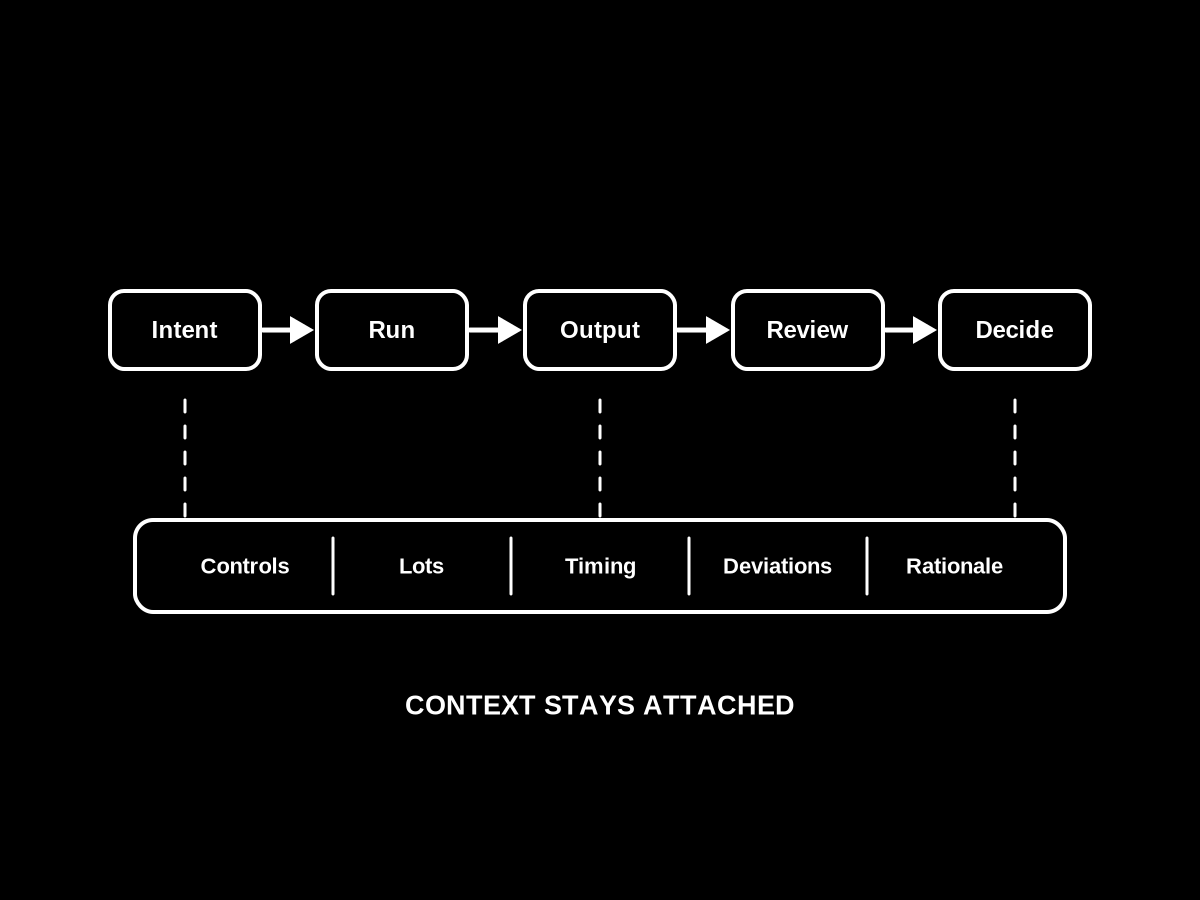
The scattered context mistake
The expensive mistake is preserving assay results without interpretable context. A table of values, if separated from controls, timing, reagent lots, sample condition, protocol deviations, instrument behavior, and scientist judgment, creates unreliable data for analysis.
Why the result loses meaning
Wet lab evidence degrades moving toward analytics. A wet lab result is more than a value; it's a value produced under specific biological, procedural, instrumental, and interpretive conditions. Reusability requires understanding what was tested, how, under what conditions, control behavior, and interpretation rationale.
Context fragments across systems. ELNs hold protocols, instruments raw data, spreadsheets normalization, slide decks interpretations, and Teams threads suspicions. The complete record may exist, but not in a reconstructible format.
Crucial context losses are mundane: uninterpreted control behavior, unlinked reagent lot changes, ignored timing differences, or siloed cell state. Plate effects, instrument drift, or subtle contamination may reside in unstructured text, inaccessible to downstream systems.
Failed runs are critical. Prioritizing only successful results distorts the evidence base. Analytics might only see polished output, not conditions where assays became unreliable. For model training or target selection, failures inform as much as successes.
Over-reliance on metadata fields creates brittle templates that scientists bypass. Not every observation needs a controlled field; narrative is crucial for complex judgments. The challenge is balancing structured data with narrative context, controlled vocabulary, linkage, and review triggers.
Later systems depend on the evidence record. A RAG system can't recover missing sample state. A dashboard can't explain trends if reagent lots or passage drift were uncaptured. A model can't distinguish clean negatives from ambiguous ones if that ambiguity was erased. AI and advanced analytics require durable evidence that sustains interpretation across time, teams, and tools.
Capturing context at the bench
SignalForge traces the path from experimental intent to decision, analyzing assay context: the decision it supports, biological system, controls, failure conditions, expert judgment, and downstream reuse requirements.
We examine the workflow from design through execution, instrument output, analysis, interpretation, review, and storage. We pinpoint where interpretive context is created, lost, duplicated, or becomes too informal for reuse.
SignalForge categorizes information into four areas:
First, consistently captured structured metadata: sample IDs, assay versions, reagent lots, plate maps, timepoints, passage numbers, and run IDs.
Second, reviewable evidence linked to results: controls, QC flags, exclusion rationales, failed run classifications, normalization choices, deviations, and acceptance criteria.
Third, scientific narrative for nuanced judgment: ambiguous morphology, unexpected biology, operator judgment, caveats, and rationale for final calls.
Fourth, review gates: determining if results are reusable, require caveats, need reruns, or should be excluded from analytics.
For a Scan, SignalForge assesses one assay family or workflow to identify high-risk context losses. For a Pilot, we test a bounded capture pattern with real workflows and data. For Run, we provide ongoing advisory across evolving assays and data reuse decisions.
SignalForge complements quality and regulatory efforts, ensuring the evidence base supports intended decisions.
Capture pressure points
Assay purpose dictates essential context for preservation.
Controls must connect to final decisions.
Failed runs and caveats define assay limits and must remain in the record.
Tracking changes in reagents and sample handling explains variation.
Protocol changes, exceptions, or workarounds need specific run documentation.
Instrument IDs, maintenance, calibration, and export settings ensure comparable data.
Passage number, viability, and storage conditions are critical for interpretation.
ELN entries, instrument exports, and decision artifacts need robust connections.
Capture requirements must align with lab reality to prevent workarounds.
Clear ownership is needed to determine when a record is reusable.
Capture blueprint
A Wet Lab Evidence Capture Scan concisely assesses one assay workflow, providing:
A map detailing current locations of experimental design, notes, outputs, analysis, interpretation, and review artifacts.
A register identifying where critical context (controls, timing, sample state, deviations, rationale) is lost or weakened.
A definition specifying minimum required information for downstream analytics and AI.
A distinction between structured fields, controlled terms, linked artifacts, required free text, and optional notes.
Recommendations for when results should be marked reusable, caveated, excluded, rerun, or escalated.
An assessment of whether to proceed, repair capture, or halt AI/data efforts due to evidence gaps.
A scoped recommendation for a pilot focusing on one workflow, assay family, and downstream use case.
A bounded capture trial
A 4-6 week Pilot tests an evidence capture pattern for a specific assay workflow. It uses real or historical runs, defines minimal reusable records, adds structured metadata, preserves scientist rationale, links ELN records to outputs, classifies run failures, and establishes a review gate for analytical release.
This pilot is not a full informatics overhaul. It confirms if a team can capture sufficient context for other qualified teams to interpret, reuse, and challenge the evidence without relying on memory.
Adopt, retrofit, or defer
The executive decision involves assessing whether wet lab evidence is ready for reuse or automation, or if capture practices need repair. This fork allows leadership to proceed with pilots where evidence supports interpretation, fund targeted capture repairs, quarantine unreliable datasets, or delay high-cost programs. By confronting this issue, organizations avoid misattributing failures to tooling or AI, recognizing lost interpretive context instead. SignalForge empowers leaders to make clear decisions: advance with a bounded pilot, enhance evidence capture, selectively rescue historical data, redefine review processes, or postpone automation until the lab record meets truth-telling standards.
Capture FAQ
No, this ensures a future reviewer can interpret results without reconstructing the experiment from scattered files.
No, balance structured fields with narrative for scientific judgment; define what needs control, linkage, or free text explanation.
AI can connect existing evidence but cannot recover context that was never recorded; it aids, but doesn't substitute source capture.
Send this to begin
Send SignalForge an assay workflow and its current artifacts: an ELN entry, instrument export, analysis spreadsheet, plate map, final decision memo, example failed run, and any metadata template or SOP. Focus on a workflow where current reuse is problematic, such as a dataset for analysis, a dashboard to build, or historical results needing explanation.