Run event definition
SignalForge inspects how the organization defines a run, including instrument, assay, operator, method, samples, controls, and acceptance criteria.
Playbook 03
Instruments generate valuable files, but the path from run event to authoritative record is still fragile.
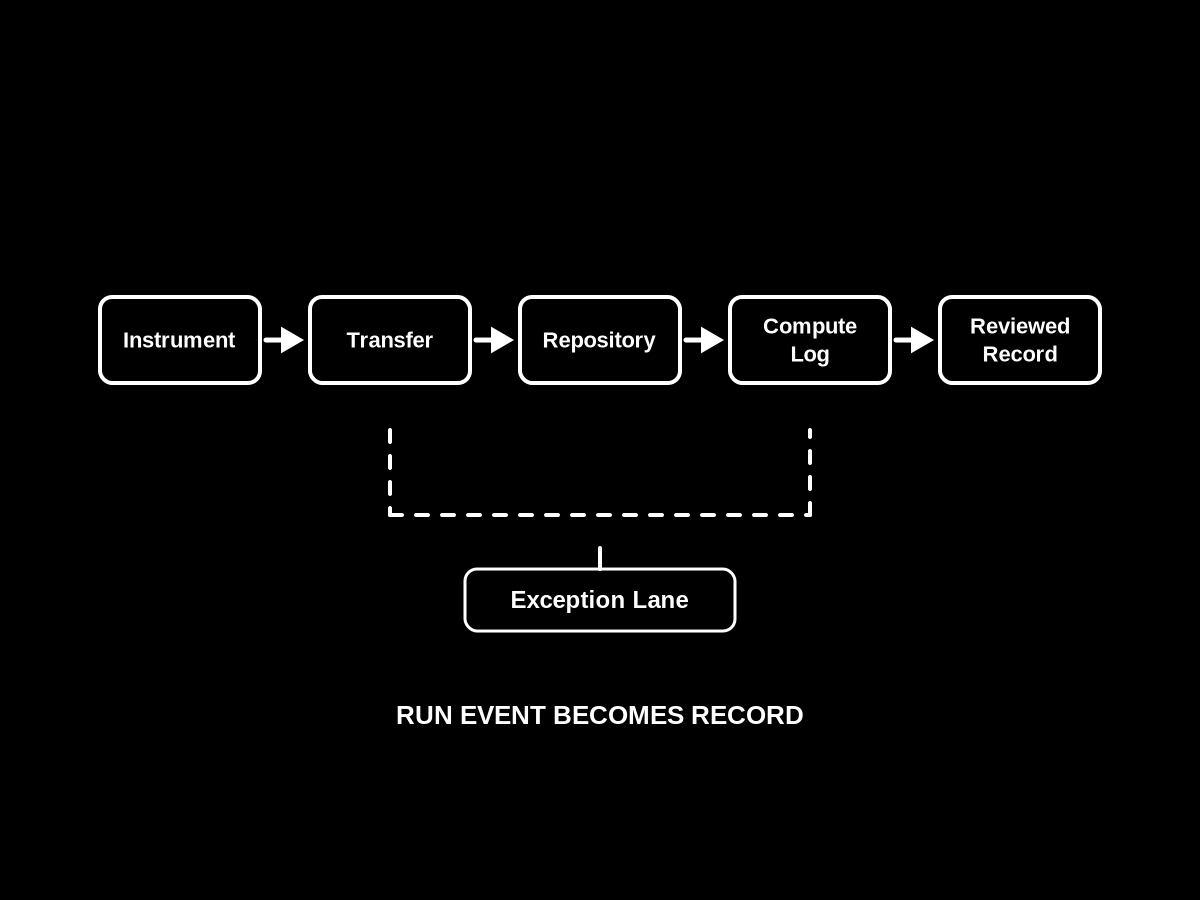
The fragile pipeline mistake
Buying infrastructure without establishing scientific identity, transfer state, processing lineage, exception handling, review status, ownership, or decision readiness creates ambiguity, rather than evidence.
Why the run is not the record
Instrument output creation outpaces organizational governance from run event to repository record. Manual processes like renaming CSVs or copying image folders undermine data authority.
Breaks often occur at identity. Instruments produce files, but scientific decisions rely on discrete objects. Inconsistent representation of identities (samples, plates) across systems forces inference from informal cues.
State is another break. Storage systems hold files, but rarely indicate completion, usability, or review status. Data state is dispersed across local folders, tickets, chat, and informal knowledge, risking issues with failed controls or re-runs.
Lineage also breaks. Downstream teams receive summary reports lacking traceability to input files, method versions, parameters, or review decisions. This makes outputs harder to defend and AI/analytics brittle.
Ownership splits the workflow. Lab teams, informatics, data engineering, computational teams, scientific reviewers, and business leaders all own parts. Without clear transition ownership, exceptions fall between groups, indicating fundamental evidence flow problems.
The result: organizations with modern storage still depend on experts to validate data. Downstream scientists trust summaries due to social validation, not inspectable data paths. Infrastructure becomes a file dump, not a trustworthy data source.
Hardening the path
SignalForge addresses this as a workflow and provenance issue, focusing on one real instrument workflow with outputs, metadata, exceptions, and a downstream decision. We trace the path from run event through file creation, transfer, storage, processing, exception handling, results, review, and decision use. The goal is to identify scientific meaning loss, ambiguous authority, and reliance on local convention.
The target pattern involves registering instrument outputs against a durable run record, securely transferring files to versioned object storage, linking object metadata to database records, triggering cloud compute with logged parameters, writing structured results, recording exceptions, and marking reviewed outputs for downstream systems. SignalForge provides advisory and diagnostic services—clarifying workflow, identifying gaps, designing pilots, and helping leadership assess platform assumptions—without replacing regulated validation or clinical judgment. Our Scan → Pilot → Run model establishes problems, tests solutions, and maintains oversight as workflows evolve.
Pipeline pressure points
SignalForge inspects how the organization defines a run, including instrument, assay, operator, method, samples, controls, and acceptance criteria.
SignalForge examines files produced: raw files, exports, logs, sample sheets, method files, images, and reports.
SignalForge inspects file movement from instrument workstations into shared drives, object storage, or downstream systems.
SignalForge identifies official systems or objects at each stage, and where authority is unclear.
SignalForge tests whether IDs (sample, run, etc.) join cleanly across systems.
SignalForge inspects how raw objects, corrected files, processed outputs, and reports are versioned, overwritten, or replaced.
SignalForge inspects how processing starts, which script/workflow version runs, parameters used, and if compute logs link to outputs.
SignalForge examines how failed controls, transfers, uploads, duplicates, re-runs, exclusions, and manual corrections are recorded.
SignalForge inspects how outputs move from generated to reviewed and usable, including approval/rejection/supersede processes.
SignalForge inspects how scientists, AI teams, and executives consume outputs and if reports preserve sufficient lineage for decisions.
Flow blueprint
A Scan produces an instrument to repository workflow map for one priority data flow, from run event to downstream decision.
Identifies conflicting definitions of official files, records, database rows, object versions, and reports.
Assesses core identities: sample IDs, run IDs, assay context, reagent lots, control status, method versions, processing state, and review status.
Lists gaps in metadata and identifier consistency across systems.
Itemizes exceptions like failed transfers, partial uploads, duplicate files, re-runs, and manual corrections.
Separates storage availability from trustworthy evidence infrastructure.
A bounded pipeline trial
A 2-8 week Pilot tests an instrument ingestion pattern for a high-value workflow. It registers a run, captures metadata, transfers raw outputs to versioned storage, creates linked database records, triggers controlled processing, records parameters and exceptions, produces structured results, and marks reviewed outputs as decision-usable. Success means a scientist, data owner, and executive can trace a result to its exact run, files, metadata, processing, exception history, and review state without informal knowledge.
Harden, replace, or contain
This playbook enables an executive decision: repair instrument data flow, pilot a focused ingestion/repository pattern, challenge a platform assumption, or stop conflating storage with evidence infrastructure. The wrong next step is costly, as investing in cloud, lakehouses, or AI tools won't solve basic scientific questions about data authority, provenance, review, or decision fitness if the underlying flow is broken.
The choice isn't "modernize everything" versus "do nothing." If nearly functional, fund targeted repairs. If strategically important but ambiguous, fund a bounded pilot. If a platform fails, challenge the assumption early. If a workflow is too immature for AI, redirect efforts to building a defensible data substrate.
Pipeline FAQ
Cloud storage holds files, but doesn't make them scientifically authoritative; a precise workflow record with identity, metadata, versioning, states, exceptions, and review status is often missing.
It's both: data engineering provides implementation, but scientific operations defines the logic for runs, controls, re-runs, metadata, and decision-ready states.
No, but the specific workflow feeding the AI must have sufficient provenance; a targeted Scan or Pilot can assess this readiness.
Send this for the screen
Send SignalForge one representative instrument workflow: instrument type, files produced, systems touched, a downstream output example, and the current pain point. Include examples of file names, sample sheets, processing logs, or review steps. SignalForge will use this to assess whether the problem lies in file movement, metadata identity, processing lineage, review state, ownership, or platform fit.