Experiment to decision timeline
Map elapsed time from design through final decision, separating active work from waiting, rework, and review delays.
Playbook 13
Experiments are finishing, but decisions are not getting faster.
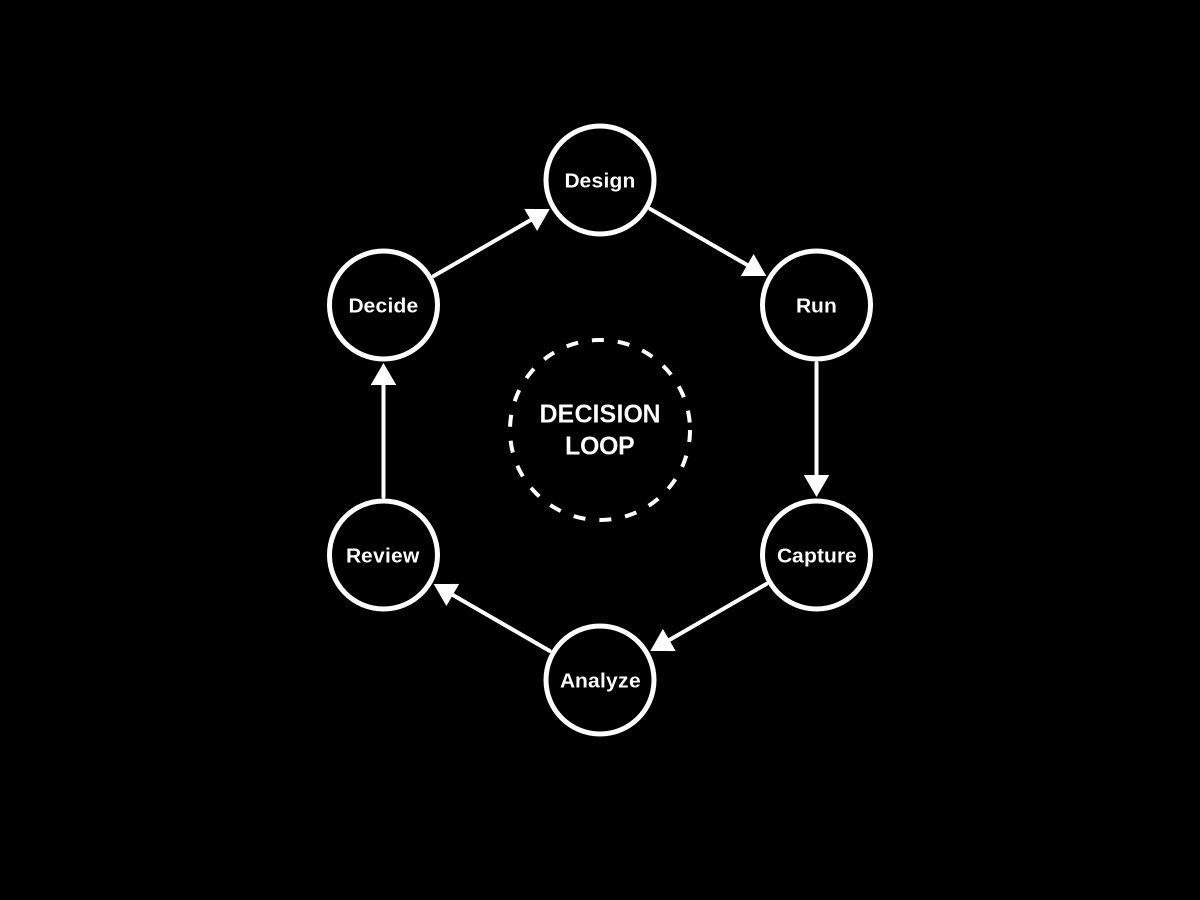
The throughput illusion
Treating throughput as a staffing or automation problem before proving where the experiment-to-decision cycle stalls is an expensive mistake. Delays often stem from missing context, unclear ownership, batch review timing, analyst rework, or leadership forums that meet on a calendar, not when evidence is ready.
Why decisions stall
Experiment throughput is a chain of timed events: design, execution, data capture, movement, metadata, analysis, interpretation, documentation, review, and decision. Different teams manage and optimize each part, often with conflicting definitions of "done."
For example, the lab defines "completion" as plates run, while analytics define "readiness" as usable files with metadata. Reviewers need an interpretation with controls; leadership needs a clear recommendation. These conflicting definitions cause delays where analysts reconstruct experimental intent or interpret fragmented metadata from ELN, spreadsheets, and shared folders.
Increasing experiments increases unresolved evidence. More assays generate more meetings; analysts lack context. Review bottlenecks when scheduled arbitrarily or packets are incomplete. Automation helps only if workflows are visible. The question is: "Where does evidence stop, why, and what decision waits on it?" The answer may be a template, standard, handoff change, or specific automation, not always more staff.
Compressing the cycle
SignalForge improves experiment cadence by mapping one experiment-to-decision workflow, like an assay series. We identify the target decision and work backward through the evidence chain: what is sufficient to act, who decides, what evidence is needed, what metadata must travel, which analysis steps are deterministic, and where review adds value.
In a Scan, SignalForge inspects current cadence across execution, data, analytics, documentation, review, and decision points. This exposes wait times, rework, queues, dependencies, and mismatched readiness definitions, examining ELN entries, SOPs, instrument exports, and storage structures. We categorize steps for standardization, automation, or human review, prioritizing interventions based on workflow stability and ambiguity.
For a Pilot, SignalForge defines a bounded test to compress one workflow for a specific assay or data product. This tests interventions under real constraints (evidence completeness, ownership, review), measuring latency reduction, analyst clarification time, and decision clarity.
In Run, SignalForge provides advisory on throughput priorities, vendor claims, AI opportunities, workflow redesign, and decision governance. The focus remains practical: reducing ambiguous handoffs, rework loops, and improving evidence readiness for executive decisions.
Cadence pressure points
Map elapsed time from design through final decision, separating active work from waiting, rework, and review delays.
Compare how the lab, analytics team, reviewers, and leadership define completion, readiness, and decision quality.
Inspect whether controls, reagent lots, protocol deviations, failed wells, sample conditions, and hypothesis context are captured before analysis.
Examine how instrument outputs, ELN records, LIMS fields, spreadsheets, object storage paths, and pipeline inputs are connected or manually reconciled.
Evaluate whether analysts receive enough context to run the right workflow without repeated clarification.
Inspect whether scientific, quality, technical, or leadership review happens when evidence is ready or only when a standing meeting occurs.
Identify repeated causes of reruns, re-analysis, reformatting, missing fields, ambiguous identifiers, and late-stage reinterpretation.
Determine whether dashboards and reports are changing decisions or merely displaying results requiring manual reconstruction.
Assess which steps have stable inputs, rules, owners, and outputs, versus those too ambiguous for responsible automation.
Inspect whether final recommendations are supported by traceable evidence, caveats, assumptions, and clear next actions.
Cadence diagnostic
A Scan produces a workflow map for one experiment-to-decision path, including active work, wait time, handoffs, queues, review gates, ownership, and rework loops.
Cadence mismatch diagnosis showing where lab execution, analytics, documentation, and decision forums operate on incompatible rhythms.
Covers required assay context, metadata, controls, file locations, QC indicators, analysis inputs, review requirements, and decision criteria.
Bottleneck ranking separating staffing constraints from metadata gaps, unclear ownership, avoidable rework, system fragmentation, review delays, and automation candidates.
First intervention recommendation: automate, staff, standardize, redesign workflow, repair metadata, change review cadence, add dashboard, narrow scope, or stop the proposed intervention.
Pilot brief with scope, success criteria, participants, evidence artifacts, risks, logging, and the executive decision the pilot informs.
A throughput trial
A 2-8 week Pilot tests one assay-to-decision workflow for a recurring experimental series. SignalForge defines intake, metadata, handoffs, analysis checks, exception logging, review timing, and decision memo format for one cycle.
The Pilot measures latency reduction from cleaner evidence flow, tracking elapsed time, analyst clarification loops, missing context, rework, review delays, and clarity of leadership recommendations.
Accelerate, redesign, or hold
This playbook helps leadership diagnose the actual throughput problem. The wrong intervention can accelerate the wrong thing: automation outpaces interpretation, more analysts process incomplete submissions, and more dashboards make delays visible without reducing them. The executive decision is whether to invest in automation, staffing, metadata repair, workflow redesign, or review cadence based on where the cycle truly stalls.
The practical fork: is the bottleneck stable enough for automation? Is it missing context, needing workflow fixes? Is it analyst overload from preventable gaps, requiring upstream standards? Or is it leadership cadence, demanding a decision-making change? SignalForge clarifies this fork, preventing wasted budget and scientific effort.
Throughput FAQ
Not solely. This playbook first diagnoses cadence, handoffs, evidence readiness, review timing, and ownership to determine optimal interventions, including automation.
Analyst overload signals a problem, but the reason matters. If caused by missing context or manual reporting, adding headcount may not fix upstream issues; the workflow reveals if the constraint is capacity, poor intake, or rework.
Yes. This model applies to diagnostics development, translational analytics, medtech evidence reviews, and AI-assisted evidence synthesis where timely decisions rely on structured evidence flow.
Bring this to the screen
Send SignalForge one recurring experiment-to-decision workflow where speed matters. Include its type, platform, example outputs, data flow, analysis, review process, intended decision, and perceived bottlenecks.
Useful materials include ELN templates, SOPs, instrument exports, analysis notebooks, dashboard screenshots, review agendas, decision memos, and automation proposals.