Current alert inventory
Inspects existing alerts (patent, publication, clinical, regulatory, BD, market, competitor) to understand recipients and ignored signals.
Playbook 18
Patents, publications, competitors, vendors, clinical updates, regulatory signals, BD opportunities, and market claims move faster than teams can synthesize them into reviewed decisions.
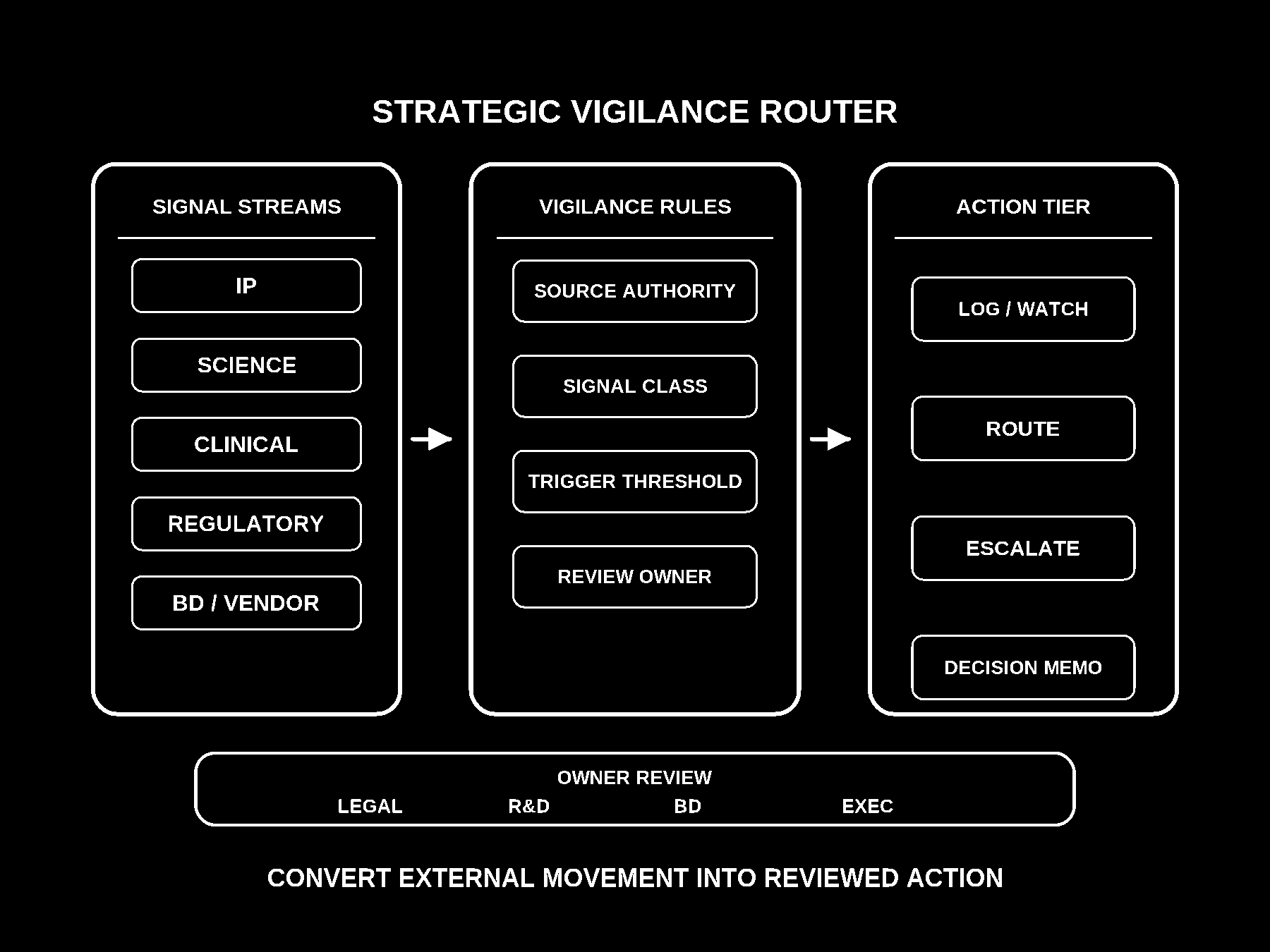
The unprotected flank
Adding more alerts without strategic vigilance creates costly blind spots. Increased volume without clear source authority, signal taxonomy, thresholds, ownership, confidence levels, or decision routing makes organizations less informed.
Why monitoring misses it
External intelligence is collected, but not converted into decisions. Life sciences organizations use fragmented monitoring, with various teams tracking patents, publications, clinical trials, regulatory changes, BD opportunities, scientific advancements, market claims, and vendor dashboards.
The breakdown occurs between collection and interpretation. A patent alert needs to answer if it affects internal platforms, targets, or indications, and if it requires legal, scientific, or BD review. A publication's relevance depends on assay context, patient population, and reproducibility. Clinical, regulatory, BD, and vendor signals become noise if routed generically, needing specific internal context to be meaningful.
Agentic systems alone create automated noise without a well-designed workflow. If not guided by specific actions (act, watch, route, challenge, diligence, escalate, or ignore), agents summarize documents without guiding action.
External intelligence is often organized by source, not by decision. A robust IP and competitive defense layer must start with leadership's actual decisions: defend an asset, adjust a program, request counsel, open diligence, challenge a claim, update a memo, or change competitor watch status.
Turning signal into defense
SignalForge designs the operational layer between external information and executive action.
In a Scan, SignalForge examines current monitoring: source classes, alert streams, subscriptions, and escalation paths, identifying where signals are lost due to vague thresholds or unclear review roles.
SignalForge frames target vigilance by defining source classes (e.g., patent filings, publications, clinical trials, regulatory communications) and a signal taxonomy (e.g., IP movement, scientific proof movement, clinical movement, strategic anomaly).
SignalForge does not replace expert functions like legal or regulatory review; it designs evidence handling, metadata, routing, and decision workflow, ensuring experts receive timely, well-formed signals.
In a Pilot, SignalForge tests one monitored area, like a specific modality or competitor set, to refine signal capture, classification, routing, and memo conversion under real constraints.
In Run, SignalForge supports ongoing system cadence: scope updates, signal quality review, threshold tuning, and decision loop maintenance. The goal is a persistent vigilance system that adapts as programs and evidence standards evolve.
Coverage gaps to map
Inspects existing alerts (patent, publication, clinical, regulatory, BD, market, competitor) to understand recipients and ignored signals.
Classifies sources by authority, freshness, ambiguity, and reviewer type; evidence types are not equivalent.
Examines how competitors, subsidiaries, academic labs, and inventor networks are tracked across sources.
Inspects how the organization categorizes new filings, assignments, claim changes, jurisdictions, oppositions, licenses, and overlap with internal assets.
Assesses publication filters based on assay context, model, sample type, endpoint, omics workflow, and program relevance.
Reviews which registry changes, endpoint shifts, label updates, guidance, and milestones trigger review versus passive logging.
Inspects how deals, financings, partnerships, grants, conference signals, and market claims move to BD screens or executive review.
Reviews whether signal summaries separate facts, citations, interpretation, impact, owner, and decision forum.
Inspects where legal, scientific, BD, regulatory, or executive reviewers enter the workflow and their accountability.
Examines prompts, model logs, retrieval sources, permissions, output formats, versioning, and auditability for AI-assisted monitoring.
Diagnostic deliverables
A SignalForge Scan provides a practical design for piloting an agentic IP and competitive defense layer.
A map of alert streams, systems, subscriptions, owners, review points, and decision forums.
A model showing which sources support specific conclusions.
A signal taxonomy for IP, scientific, clinical, regulatory, BD, vendor, commercial, and strategic signals.
A matrix defining what should be logged, watched, summarized, routed, escalated, or memoed.
A map of reviewer ownership across BD, R&D, legal, regulatory, scientific, strategy, and leadership.
A template separating facts, citations, context, uncertainty, relevance, owner, and decision request.
A register covering legal, privilege, hallucination, licensing, and escalation risks.
A recommendation for a bounded monitoring pilot, or a stop recommendation if the organization is unprepared.
A scoped competitive watch
A 2-8 week Pilot can test an agentic monitoring layer for a specific competitor set or strategic area. The pilot defines sources, entities, keywords, exclusions, signal classes, and alert thresholds. AI can classify and draft signal briefs, but human reviewers manage escalation.
The test measures whether the workflow produces fewer, better, cite-able signals, classified, routed, reviewed, and suitable for decision memos. Leaders' ability to understand signal importance, review history, decision impact, and next steps judges a successful pilot, not alert volume.
The leadership call
This playbook helps leadership determine if an agentic monitoring layer will reduce blind spots or create noise. If the organization lacks clear source authority, signal thresholds, reviewer ownership, memo standards, or decision routing, agents will likely accelerate confusion. Investing in tooling without an effective operating model leads to missed competitive moves despite increased summaries.
The better path is selective: leadership determines which signals deserve human review, which sources trigger escalation, and which areas require continuous monitoring. BD receives opportunity briefs, R&D gets scientific relevance notes, Legal receives pre-formed issue packets, and executives get concise memos for specific decisions: monitor, diligence, challenge, defend, partner, escalate, or stand down. This avoids wasted executive attention, duplicated effort, overreaction, missed competitive movement, and decision forums clogged with poor intelligence.
Questions buyers ask
Yes, this focuses on legitimate, controlled competitive intelligence from public, licensed sources, adhering to legal and compliance reviews.
An agent assists with monitoring, classification, and routing, but human review and context are essential for legal, regulatory, or strategic judgments.
If existing tools produce unowned alerts disconnected from decision-making, the core problem is refining the operating layer to convert external movement into strategic choices, not just adding more feeds.
Bring this to the screen
Send SignalForge samples of your current external intelligence: patent/publication alerts, competitor watchlists, clinical/regulatory tracking examples, BD screens, vendor summaries, executive memo templates, source subscriptions, and key signals for leadership. SignalForge will assess if you need more monitoring, better thresholds, a memo workflow, reviewer ownership, or a bounded agentic pilot based on these materials.