Use case portfolio and ranking
SignalForge inspects and scores proposed workflows by value, feasibility, risk, and model dependency.
Playbook 16
Executives compare APIs, enterprise platforms, private cloud, local models, fine tuning, RAG, or custom integrations before proving which workflows justify the burden.
The premature build mistake
Buying private frontier model capability before proving workflow justification is a costly error. Without ranked workflows, evaluation standards, and clear review, organizations risk heavy infrastructure spending while data quality, access, and unclear business value remain blockers.
Why in house stalls
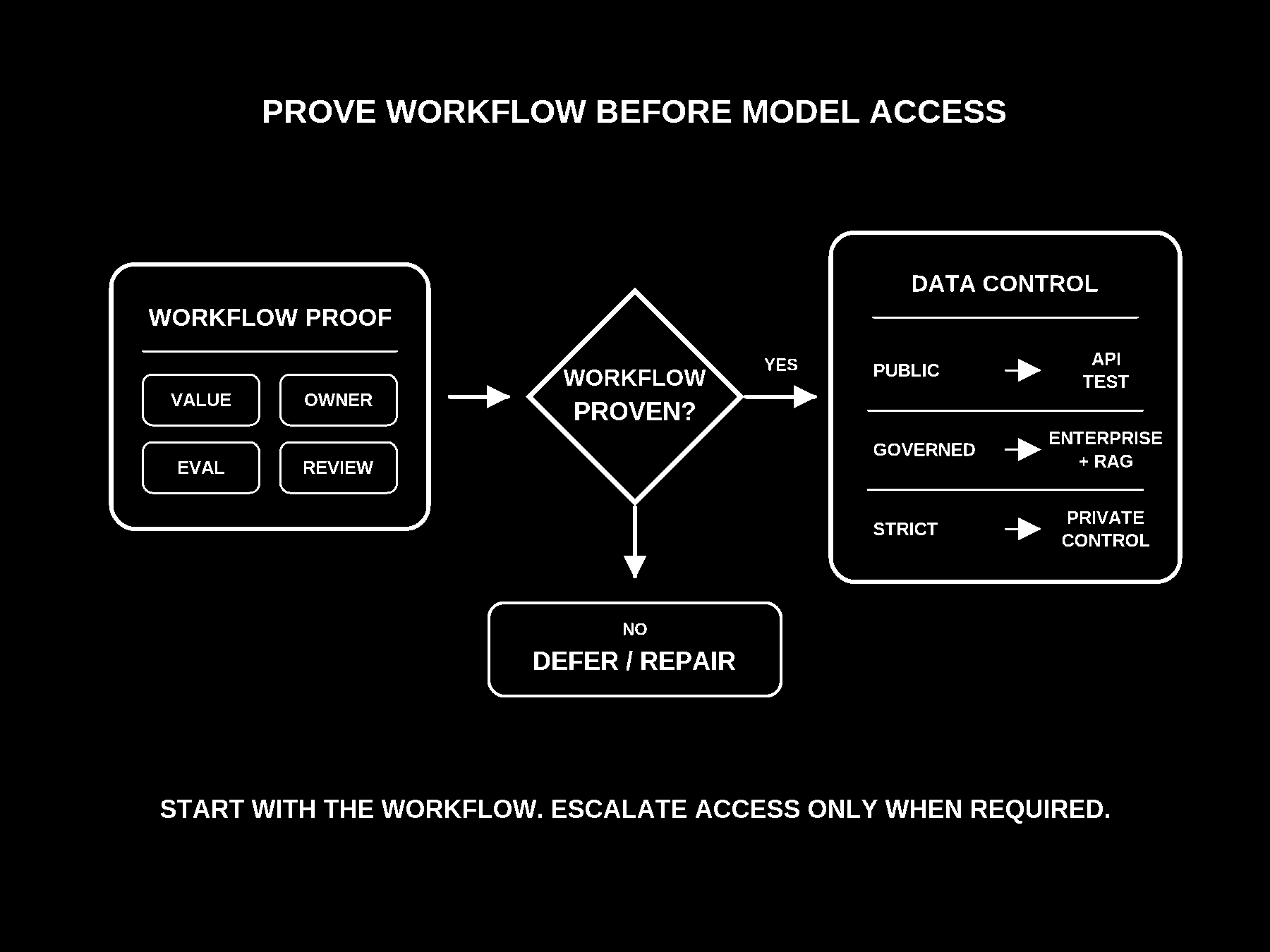
Model access decisions are often premature. Leaders choose architectures (APIs, private cloud, local models, RAG, fine tuning) before identifying critical workflows. Architecture should reflect evidence, sensitivity, workflow value, and operating constraints.
In life sciences, no single model access strategy fits all use cases. A BD team summarizing public patents has a different risk profile than a translational team analyzing unpublished biomarker data. Workflows vary widely in inputs, sensitivity, controls, review, and consequences.
"Sensitive data" covers diverse categories: unpublished biology, patient data, clinical records, proprietary assays, invention disclosures, regulator correspondence, or routine SOPs. Each demands different access, logging, retention, and architectural decisions; conflating them leads to over-engineered or under-controlled systems.
Evaluation is a common failure point. Demos impress, but organizations need test sets reflecting messy internal data: ambiguous notes, incomplete metadata, and domain-specific review criteria. Models may perform well generally but fail on citation, omission, version awareness, or distinguishing exploratory science from decision-grade evidence.
Costs are often underestimated. Model access costs include tokens, compute, identity integration, document classification, audit logging, reviewer time, security review, change control, and user support. Local models incur maintenance; fine-tuning introduces refresh obligations; RAG exposes source hygiene and permissions weaknesses.
"Readiness" requires a specific workflow with an owner, defined decision, allowed data, source systems, evaluation cases, acceptance thresholds, review gates, cost expectations, and a credible integration path. Absent this, use constrained APIs for low-sensitivity tasks, build RAG over governed evidence, or defer significant investment.
Sizing the build
SignalForge helps leaders separate model access ambition from workflow readiness. We inventory candidate workflows, framing them operationally: user, decision supported, evidence touched, risks, output review, logs needed, and success metrics.
For each workflow, we examine sensitivity classes and data flows, focusing on what data enters prompts, indexes, context windows, and logs. Assay context, omics outputs, ELN entries, BD notes, and patents do not all require identical model access patterns.
SignalForge compares model access options against the workflow portfolio. Vendor APIs suit bounded, low-sensitivity analysis. Managed enterprise platforms fit central identity and control needs. Private hosting is for high-value workflows needing strict data control. RAG is better for governed internal evidence. Fine-tuning is premature without stable examples and a measurable behavior gap. Local models are niche, if performance and maintenance are honestly modeled. Sometimes, deferring frontier model spending to fix the evidence substrate is best.
SignalForge’s Scan → Pilot → Run model grounds decisions:
A Scan creates a readiness view: ranked workflows, sensitivity classes, architectural options, governance burden, evaluation gaps, and pilot recommendations.
A Pilot tests one bounded workflow under real constraints: actual documents, metadata, permissions, review gates, prompts, logs, and cost tracking.
Run provides ongoing advisory across model access, vendors, data, agents, evaluation, and risk as the organization scales what works and stops what doesn't.
SignalForge complements existing validation and review processes, providing cleaner evidence and sharper options, avoiding architecture by anecdote.
Build readiness pressure points
SignalForge inspects and scores proposed workflows by value, feasibility, risk, and model dependency.
SignalForge separates sensitive data types: unpublished science, patient data, and IP.
SignalForge traces prompts, documents, model outputs, and logs.
SignalForge examines sources like SharePoint, ELNs, and LIMS for accessibility and trustworthiness.
SignalForge assesses test sets, reviewer rubrics, acceptance thresholds, and citation requirements.
SignalForge identifies owners for scientific, operational, technical, security, and executive decisions per workflow.
SignalForge inspects required scientific, quality, legal, medical, regulatory, or business reviews.
SignalForge models costs: licenses, tokens, compute, storage, integration, monitoring, and reviewer time.
SignalForge identifies necessary integrations: SSO, document permissions, and API connections.
SignalForge compares vendor APIs, managed platforms, private hosting, local models, RAG, and fine-tuning.
In house readiness memo
A Frontier Model Readiness Map showing candidate workflows, user groups, decision points, evidence sources, sensitivity classes, and recommended model access patterns.
A ranked portfolio separating near-term candidates from workflows too low-value, risky, or undefined.
A sensitivity and data flow matrix demonstrating information movement through prompts, retrieval stores, and logs.
A model access options brief comparing vendor API, managed enterprise, private hosting, local, retrieval, fine-tuning, and deferral paths.
An evaluation readiness checklist covering test sets, review rubrics, acceptance thresholds, and citation requirements.
Includes model access, cloud compute, integration, security review, monitoring, logging, and reviewer time.
A recommended first pilot or stop recommendation, with rationale based on workflow value, sensitivity, and feasibility.
A bounded build test
A 4-6 week Pilot could test a governed scientific intelligence workflow for a translational or BD team to assess frontier model access for internal evidence synthesis.
The pilot might use public patents, publications, internal target memos, assay notes, and omics summaries from governed SharePoint or object storage. It would compare a managed enterprise model interface, retrieval over internal documents, and a constrained API workflow. We would measure citation accuracy, omission risk, handling conflicting evidence, sensitivity violations, reviewer time, cost per memo, logging quality, and whether it yields decision-ready summaries.
The goal is to determine if this workflow deserves enterprise platform access, private retrieval, tighter governance, fine-tuning exploration, or no additional frontier model investment yet.
Build, buy, or wait
This playbook helps leadership decide on model access based on workflow value, sensitivity, evaluation readiness, governance load, cost, and integration reality, not vendor pressure or fear of falling behind.
The avoided bad spend is substantial. Companies often commit to private hosting, enterprise licenses, and architecture before proving workflow necessity. The fork is clear: either high-value workflows justify controlled frontier model access for evidence-based investment, or the current portfolio isn't ready. In the latter case, leadership avoids premature infrastructure spend, redirecting effort toward data hygiene, permissions, evaluation sets, and lower-burden model access for safer use cases. Failure is conflating architecture selection with readiness.
In house build FAQ
Not automatically. Some workflows need private hosting, others managed platforms or APIs. First, classify data and workflows: what data enters the model, is retrieved, logged, reviewed, and what decision is affected?
Sometimes, but often premature. Fine-tuning works best with stable examples and an evaluation harness showing a gap not solvable by RAG or prompting. Fine-tuning on messy internal documents can perpetuate confusion.
A fast, evidence-based recommendation is possible. A 1-2 week Scan identifies plausible frontier model candidates versus those blocked by unclear ownership, weak metadata, or missing evaluation. This prevents expensive decisions based on incomplete workflow evidence.
Send this for the screen
Send SignalForge your proposed AI use cases, model access options, data sensitivity concerns, sample workflow artifacts, and the decision leadership is trying to make.
Useful materials include vendor proposals, platform comparison notes, security questionnaires, sample prompts, model logs, folder examples, SOPs, omics summaries, assay docs, BD intelligence templates, patent/publication review workflows, governance drafts, and any internal memos advocating for specific integration strategies.